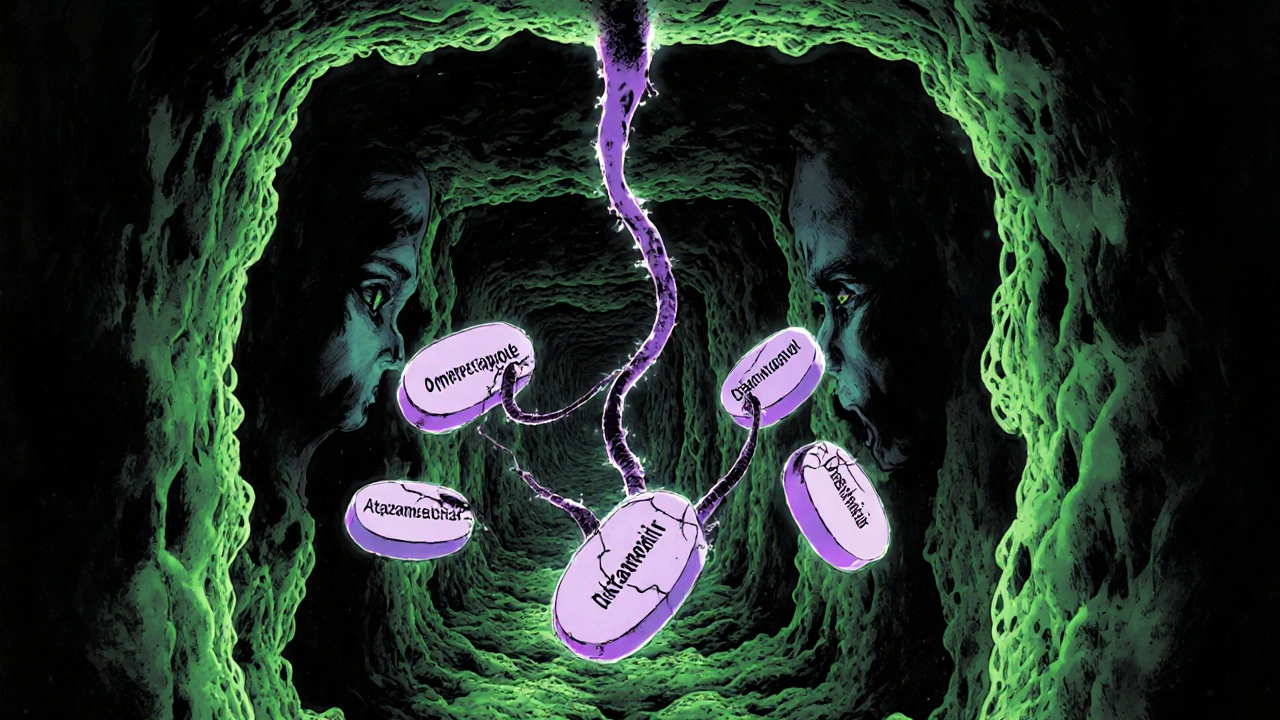
Most people think acid-reducing medications like omeprazole or famotidine are harmless heartburn fixes. But what if those pills are quietly making your blood pressure medicine, antifungal, or even HIV treatment useless? That’s not speculation-it’s documented, measurable, and happening to thousands of people right now.
How Acid-Reducing Drugs Change Your Gut Environment
Proton pump inhibitors (PPIs) like omeprazole, esomeprazole, and lansoprazole, and H2 blockers like famotidine and ranitidine, work by turning down stomach acid. Normal stomach pH hovers between 1.0 and 3.5 when you’re fasting-strong enough to break down food and kill bacteria. These drugs raise that pH to 4.0 or even 6.0. That sounds mild, but it’s enough to flip the chemistry of many drugs you take at the same time. The key lies in something called the Henderson-Hasselbalch equation. It’s not as complicated as it sounds. It just says: the more acidic the environment, the more a weakly basic drug stays dissolved and ready to be absorbed. When you raise the pH, those same drugs turn into a non-soluble form. They don’t dissolve well. And if they don’t dissolve, your body can’t absorb them. Here’s the catch: most oral drugs are weak bases. About 70% of them, according to recent drug database analyses. That includes common medications like atazanavir (for HIV), dasatinib (for leukemia), and ketoconazole (for fungal infections). These drugs rely on stomach acid to dissolve before they move into the small intestine, where most absorption happens. If they don’t dissolve in the stomach, they never get to the finish line.The Real-World Impact: When Medications Stop Working
The numbers don’t lie. When atazanavir is taken with a PPI, its absorption drops by 74% to 95%. That’s not a minor dip-it’s therapeutic failure. One patient on Reddit shared their story: their HIV viral load jumped from undetectable to over 12,000 copies/mL after starting omeprazole for heartburn. Their infectious disease doctor confirmed it: a textbook interaction. Dasatinib, used to treat chronic myeloid leukemia, sees about a 60% drop in absorption with PPIs. A 2023 study of over 12,500 patients found those on both drugs had a 37% higher chance of treatment failure. That’s not theoretical. That’s people relapsing because their medication didn’t work. Ketoconazole, once a go-to antifungal, becomes nearly useless with PPIs. The FDA explicitly warns against combining them. Even if you take the antifungal at a different time of day, the prolonged acid suppression from PPIs means the stomach stays too alkaline for hours. It’s not about timing-it’s about how long the drug is suppressing acid. Even drugs you wouldn’t expect are affected. Some blood pressure medications, diabetes treatments, and antidepressants have shown reduced absorption. One Drugs.com user reported their blood pressure stayed 20 points higher until their pharmacist caught the interaction between Nexium and their antihypertensive.PPIs vs. H2 Blockers: Not All Acid Reducers Are Equal
Not all acid-reducing drugs are created equal. PPIs are the bigger problem. They shut down acid production for 14 to 18 hours a day. H2 blockers like famotidine only work for 8 to 12 hours. That difference matters. A 2024 study in JAMA Network Open showed PPIs reduce absorption of pH-sensitive drugs by 40% to 80%. H2 blockers? Only 20% to 40%. If you’re on a medication like dasatinib and need an acid reducer, switching from omeprazole to famotidine might be the difference between treatment success and failure. Even the formulation matters. Immediate-release pills are more vulnerable than extended-release versions. And enteric-coated tablets? They’re designed to dissolve only in the small intestine. But if stomach acid is too low, they might dissolve too early-right in the stomach-where they can get destroyed or cause irritation.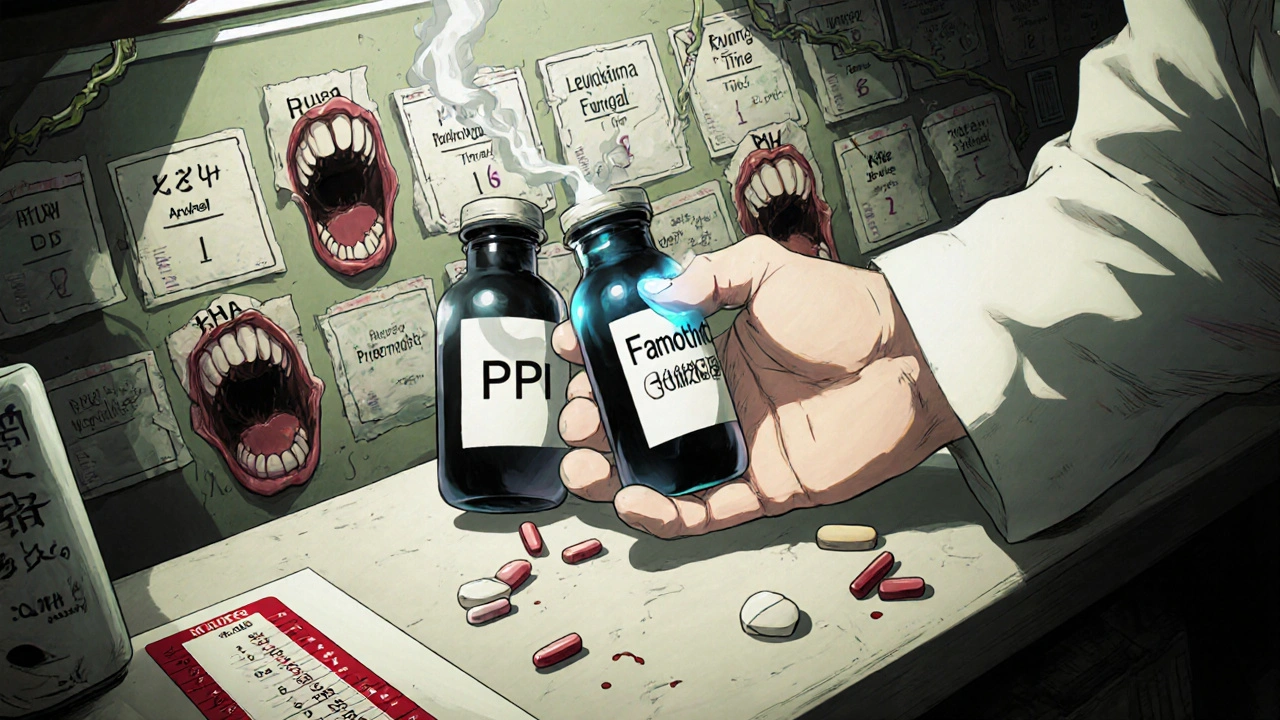
What About Acidic Drugs? Are They Safe?
Weakly acidic drugs-like aspirin or ibuprofen-behave differently. They dissolve better in higher pH environments. So, in theory, acid-reducing meds might make them absorb better. But in practice, that rarely matters. Most acidic drugs are already well-absorbed, even in acidic stomachs. The FDA notes that even when absorption increases by 15% to 25%, it doesn’t lead to toxicity or side effects in most cases. Dasiglucagon, a newer drug for low blood sugar, shows only a 15-20% increase with ARAs-and no dose adjustments are needed. The real danger zone is for drugs with a narrow therapeutic index. That means the difference between a helpful dose and a toxic one is tiny. Even a small drop in absorption can mean the drug stops working. That’s why atazanavir, dasatinib, and ketoconazole are flagged as high-risk.How to Protect Yourself
If you’re on a long-term acid reducer and take other medications, here’s what to do:- Check your meds. Look up your prescriptions on Drugs.com or the FDA’s drug interaction checker. If you’re on atazanavir, dasatinib, or ketoconazole, avoid PPIs entirely.
- Ask about alternatives. Can you switch from omeprazole to famotidine? Or use an antacid like Tums only when needed? Antacids work fast and wear off in a couple of hours-less disruption.
- Time your doses. If you must take both, take the affected drug at least 2 hours before the acid reducer. This helps, but it’s not foolproof. PPIs suppress acid for too long.
- Ask your pharmacist. A 2023 study found pharmacist-led reviews cut inappropriate ARA co-prescribing by 62%. Pharmacists see your full list of meds. They’re trained to spot these conflicts.
- Consider deprescribing. The American College of Gastroenterology says 30% to 50% of people on long-term PPIs don’t even need them. If you’ve been on omeprazole for years just because “it helped once,” talk to your doctor about stopping.

What’s Being Done About It?
The problem is big enough that regulators are acting. Between 2020 and 2023, the FDA required 28 drug labels to add warnings about acid-reducing interactions-up from just 12 in the previous five years. The European Medicines Agency has followed suit. Electronic health records now flag dangerous combinations. Epic Systems reports 78% of doctors follow the alerts. But that still means 1 in 5 miss them. Pharmaceutical companies are responding too. About 37% of new drugs in development now use pH-independent delivery systems-things like nanoparticles or special coatings that don’t rely on stomach acid to work. That’s the future. And AI is stepping in. Google Health’s 2024 prototype tool predicts drug interactions with 89% accuracy. It’s not in clinics yet, but it’s coming.Bottom Line: Don’t Assume It’s Safe
Acid-reducing medications aren’t just harmless over-the-counter fixes. They’re powerful drugs that change your body’s chemistry. And when combined with other meds, they can turn life-saving treatments into placebos. If you’re on any of these drugs-atazanavir, dasatinib, ketoconazole, or even something less obvious-don’t start an acid reducer without checking. Talk to your doctor. Ask your pharmacist. Look it up. One simple question could prevent a hospital visit, a relapse, or worse. The truth? You don’t need to live with heartburn if it’s risking your other treatments. There are safer ways. You just need to know what to ask for.Can I take antacids instead of PPIs if I’m on other medications?
Yes, antacids like Tums or Rolaids are often safer for short-term use because they work quickly and wear off in 1 to 2 hours. To minimize interaction risk, take your other medication at least 2 to 4 hours before or after the antacid. But antacids aren’t meant for daily, long-term use-they’re for occasional relief. If you need daily acid control, talk to your doctor about alternatives like H2 blockers or lifestyle changes.
Do H2 blockers like famotidine interact with drugs the same way as PPIs?
H2 blockers like famotidine do cause interactions, but they’re generally weaker and shorter-lasting. PPIs suppress acid for up to 18 hours a day; H2 blockers last 8 to 12 hours. Studies show PPIs reduce absorption of pH-sensitive drugs by 40-80%, while H2 blockers cause 20-40% reductions. For high-risk drugs like dasatinib or atazanavir, switching from a PPI to an H2 blocker can be a safer option-but only if you still need an acid reducer at all.
Why does timing matter when taking acid reducers with other drugs?
Timing helps because it gives the other drug a chance to dissolve and absorb before the acid reducer kicks in. For weak base drugs, taking them 2 hours before the acid reducer can reduce interaction by 30-40%. But this doesn’t eliminate the risk-especially with PPIs, which suppress acid all day. Timing works better with antacids or H2 blockers than with PPIs.
Are there any medications that are safe to take with PPIs?
Yes. Most acidic drugs (like aspirin or ibuprofen) are unaffected or only slightly affected. Also, drugs that don’t rely on stomach pH for absorption-like many antibiotics, statins, or beta-blockers-are generally safe. But don’t assume. Always check. The FDA lists 15+ high-risk drugs, and many others have unknown or understudied interactions. When in doubt, ask your pharmacist.
How do I know if my medication is affected by acid reducers?
Look for the drug’s pKa (acid dissociation constant). If it’s above 7, it’s likely a weak base and potentially affected. Common examples include atazanavir (pKa 5.2), dasatinib (pKa 7.2), and ketoconazole (pKa 7.4). You can find pKa values on drug databases like DailyMed or Medscape. If your drug has a narrow therapeutic index-meaning small changes in dose can cause harm-it’s especially risky. When in doubt, consult your pharmacist or use the FDA’s drug interaction checker.



11 Comments
LINDA PUSPITASARI
December 1, 2025 AT 10:52 AMOMG I had no idea my omeprazole was sabotaging my blood pressure med 😱 I switched to Tums and my numbers dropped 15 points in a week. Pharmacist saved my life 🙏
Mary Kate Powers
December 2, 2025 AT 12:00 PMThis is such an important post. So many people think heartburn meds are harmless, but they can literally make your other meds useless. I’ve seen patients relapse because of this-no one tells them. Please, if you’re on anything chronic, ask your pharmacist. It’s free advice that could save your life 💙
Steven Howell
December 3, 2025 AT 09:48 AMIt is imperative to underscore the pharmacokinetic implications of gastric pH modulation on the bioavailability of weakly basic pharmaceutical agents. The Henderson-Hasselbalch principle, while elegantly simple, remains profoundly underappreciated in primary care settings. One must exercise rigorous diligence when co-prescribing proton pump inhibitors with agents possessing narrow therapeutic indices.
Bernie Terrien
December 3, 2025 AT 22:38 PMPPIs are the silent killers of modern medicine. They turn lifesaving drugs into expensive sugar pills. Doctors write these like they’re giving out candy. Meanwhile, people are dying because no one bothered to check a damn interaction checker. Wake up.
Jennifer Wang
December 5, 2025 AT 14:17 PMBased on current evidence, the clinical significance of PPI-drug interactions is well-documented for agents such as atazanavir and dasatinib. The FDA’s 2023 update to labeling requirements reflects a growing consensus among pharmacokinetic researchers. Clinicians are advised to prioritize H2 receptor antagonists when acid suppression is clinically indicated in patients on pH-sensitive medications.
stephen idiado
December 6, 2025 AT 22:15 PMBig Pharma knows this. They don’t care. The PPI market is worth $20B. They don’t want you switching to Tums. You’re a walking profit margin.
Subhash Singh
December 7, 2025 AT 03:02 AMCould you elaborate on the pKa thresholds that define a drug as 'weakly basic'? Is there a standardized range used by regulatory agencies for identifying such interactions?
Geoff Heredia
December 7, 2025 AT 19:03 PMThey’re hiding this. I’ve seen it. The CDC, FDA, WHO-they all know. Why aren’t there warning labels on every PPI bottle? Why do pharmacies still sell them next to candy? This is chemical control. They want us dependent. I’ve got 17 meds. I know what’s going on.
Tina Dinh
December 9, 2025 AT 15:54 PMYAS THIS!! 💪 I was on omeprazole for 5 years and didn’t realize my antidepressant wasn’t working because of it. Switched to famotidine and my mood finally stabilized. Life-changing info!! 🙌❤️
Andrew Keh
December 10, 2025 AT 03:12 AMThank you for sharing this. I didn’t know acid reducers could do this. I’ll check my meds with my pharmacist this week. Better safe than sorry.
linda wood
December 11, 2025 AT 12:52 PMOh sweetie, you’re telling me you didn’t know your heartburn pill was turning your cancer drug into a placebo? 😒 Honey, you didn’t forget to read the label-you forgot to have a brain. But hey, at least now you know. Go talk to your pharmacist before you die of preventable nonsense.