Opioid Dosing Calculator for Liver Disease
Dosing Calculator
Avoid in advanced cirrhosis
Reduce by 30-50%
Transdermal preferred
Transdermal preferred
When someone has liver disease, taking opioids isn’t just risky-it’s like driving a car with a broken brake pedal. The liver doesn’t just process painkillers; it breaks them down, filters out toxins, and keeps levels safe. But when the liver is damaged, that system fails. Opioids build up. Side effects turn dangerous. And what was meant to help can end up harming-or killing.
How the Liver Normally Handles Opioids
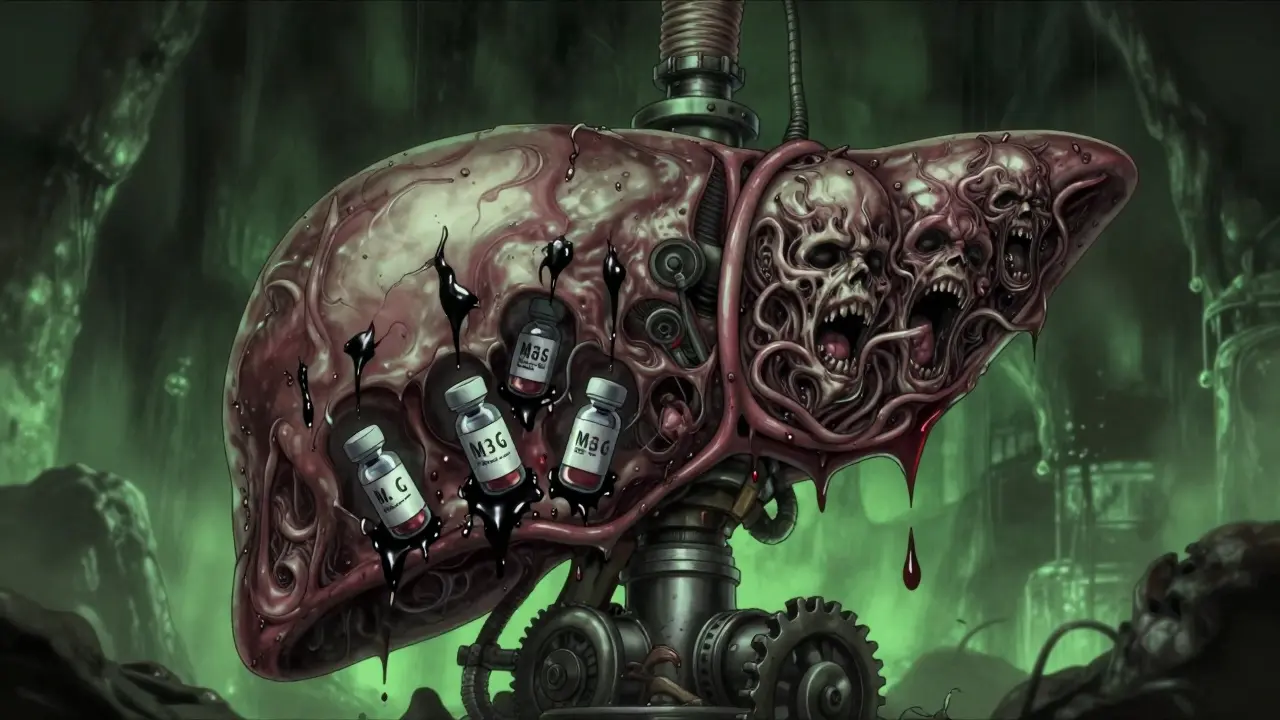
The liver is the main factory for breaking down opioids. Two key systems do the work: cytochrome P450 enzymes and glucuronidation. These enzymes turn opioids into water-soluble pieces the body can flush out through urine or bile. For example, morphine becomes morphine-6-glucuronide (M6G), which still relieves pain, and morphine-3-glucuronide (M3G), which can cause seizures and confusion. Oxycodone gets broken down by CYP3A4 and CYP2D6 into active and inactive metabolites.
These processes are precise. In a healthy liver, morphine’s half-life is about 2-3 hours. Oxycodone clears in roughly 3.5 hours. But when liver function drops, these clocks slow down. The body can’t keep up. Opioids linger. And the longer they stay, the more they pile up.
What Happens When the Liver Fails
In advanced liver disease, opioid clearance can drop by 50% or more. Studies show that in severe cirrhosis, oxycodone’s half-life jumps from 3.5 hours to an average of 14 hours-sometimes as high as 24.4 hours. That means a single dose can stay in the system for days. Plasma concentrations rise by up to 40%. The risk of overdose doesn’t just go up-it explodes.
Morphine is especially dangerous here. Its metabolites don’t clear properly. M3G builds up in the brain and nervous system, triggering tremors, hallucinations, and even seizures. M6G, while helpful for pain, also accumulates and can cause respiratory depression. In people with liver failure, even small doses of morphine can lead to life-threatening breathing problems.
And it’s not just morphine and oxycodone. Fentanyl and buprenorphine are often thought to be safer because they’re metabolized differently-but we still don’t have clear dosing rules for liver patients. Transdermal patches (like fentanyl patches) avoid first-pass liver metabolism, which helps. But absorption can be unpredictable in people with poor circulation or fluid retention, common in advanced liver disease.
Metabolism Changes Based on Liver Damage Type
Not all liver disease is the same. The type of damage changes how opioids are processed.
In alcohol-associated liver disease (ALD), CYP2E1 enzyme activity increases. This enzyme turns some opioids into more toxic byproducts. That means even if overall liver function seems stable, the body might be creating more harmful metabolites than usual.
In non-alcoholic fatty liver disease (NAFLD) and cases linked to diabetes, CYP3A4 activity drops. That’s the main enzyme that breaks down oxycodone and methadone. So drugs relying on this pathway stick around longer. A person with NAFLD might need half the usual dose of oxycodone just to avoid toxicity.
These differences matter. A patient with alcoholic cirrhosis and one with fatty liver disease might both have the same Child-Pugh score, but their opioid risks are not the same. One might be at higher risk for neurotoxicity; the other for respiratory depression. One-size-fits-all dosing doesn’t work.

Chronic Use Makes It Worse
Long-term opioid use doesn’t just affect the brain-it affects the gut, and the gut affects the liver. Opioids slow down gut movement, leading to bacterial overgrowth and leaky gut. This lets toxins from the intestines flow straight to the liver through the portal vein.
These toxins trigger inflammation. Inflammation worsens liver scarring. And worse scarring means even less ability to process drugs. It’s a vicious cycle: opioids → gut imbalance → liver damage → worse opioid metabolism → more toxicity → more damage.
This isn’t theoretical. Studies tracking patients with cirrhosis on long-term opioids show faster progression of fibrosis compared to those not taking them. The pain relief might help short-term, but the long-term cost to the liver is real.
Dosing Guidelines for Liver Disease
There’s no universal rule, but experts agree on some key principles:
- Morphine: Start with 30-50% of the normal dose in early liver disease. In severe failure, reduce the dose AND stretch out the time between doses. Never use morphine in advanced cirrhosis unless absolutely necessary.
- Oxycodone: In severe hepatic impairment, begin at 30-50% of the standard dose. Monitor closely for sedation and breathing changes. Avoid extended-release forms-they’re too risky.
- Methadone: No solid dosing guidelines exist for liver disease. It’s metabolized by multiple enzymes, so unpredictability is high. Use only under specialist supervision.
- Fentanyl and Buprenorphine: Transdermal patches may be safer, but still reduce the starting dose by 50%. Watch for skin absorption changes due to swelling or poor circulation.
- Hydromorphone and Codeine: Avoid codeine entirely-it relies on CYP2D6, which is unpredictable in liver disease. Hydromorphone is preferred over morphine but still needs dose reduction.
Always start low. Go slow. Check for signs of toxicity: confusion, extreme drowsiness, pinpoint pupils, slow breathing. If any appear, stop the drug immediately.
What’s Still Unknown
For all we know, big gaps remain. There’s no large-scale study showing exactly how much to reduce fentanyl doses in Child-Pugh Class C patients. We don’t know if buprenorphine causes more liver injury over time. And we have no validated tools to predict who will overdose based on their liver function test results.
Current guidelines rely on small studies and expert opinion-not hard data. That’s why many doctors avoid opioids altogether in advanced liver disease and turn to non-opioid options like gabapentin, acetaminophen (in low doses), or regional nerve blocks.
Alternatives to Opioids in Liver Disease
When opioids are too risky, what else works?
- Acetaminophen: Safe up to 2 grams per day in liver disease (lower than the usual 4 grams). Avoid in acute liver failure.
- Gabapentin or Pregabalin: Helpful for nerve pain. No liver metabolism-cleared by kidneys. Watch for dizziness and sedation.
- NSAIDs: Generally avoided due to kidney and bleeding risks in cirrhosis.
- Physical therapy and nerve blocks: Often overlooked but highly effective for chronic pain without drugs.
- Cannabinoids: Limited data, but some patients report relief. Not regulated, and quality varies.
The goal isn’t just to manage pain-it’s to avoid making the liver worse. Sometimes, the best pain relief isn’t a pill. It’s a physical therapist, a warm compress, or a quiet room.
Final Takeaway
Opioids aren’t off-limits in liver disease-but they’re not safe either. The liver isn’t just a filter. It’s a precision machine. When it’s broken, even small doses can become poison. Dosing isn’t about weight or age-it’s about how much liver function remains. And that changes from person to person.
If you’re managing pain in someone with cirrhosis or fatty liver disease, assume the opioid will stay longer, act stronger, and cause more side effects. Reduce the dose. Extend the time between doses. Monitor like you’re watching for a storm. And always, always consider non-opioid options first.
The truth? Many people with liver disease suffer in silence because doctors are afraid to prescribe opioids-but they’re also afraid to prescribe anything else. The real solution isn’t choosing between pain and risk. It’s finding a smarter, safer path-one that respects the liver’s limits.
Can I take morphine if I have cirrhosis?
Morphine is generally avoided in cirrhosis, especially in advanced stages. Its metabolites, M3G and M6G, build up in the bloodstream and can cause seizures, confusion, and dangerous breathing problems. If absolutely necessary, start with 30-50% of the normal dose and extend the dosing interval. But even then, the risk is high. Safer alternatives like transdermal buprenorphine or gabapentin are preferred.
Does oxycodone affect the liver more than other opioids?
Oxycodone itself doesn’t directly damage the liver, but its metabolism is heavily dependent on liver enzymes-especially CYP3A4. In fatty liver disease or cirrhosis, these enzymes slow down, causing oxycodone to build up to toxic levels. This increases the risk of overdose, sedation, and respiratory depression. It’s not the drug itself that harms the liver-it’s the fact that the liver can’t clear it properly.
Is fentanyl safer than morphine for liver patients?
Fentanyl patches may be safer because they bypass first-pass liver metabolism. But we don’t have clear dosing rules for liver disease. In advanced cirrhosis, fentanyl can still accumulate due to reduced blood flow and protein binding changes. While it’s often chosen over morphine, it’s not risk-free. Dose reductions of 50% are recommended, and patients must be monitored closely for sedation.
Can opioids make liver disease worse?
Yes. Long-term opioid use disrupts the gut microbiome, leading to increased gut permeability. This allows bacterial toxins to reach the liver, triggering inflammation and accelerating fibrosis. Studies show patients on chronic opioids for pain have faster progression of liver scarring compared to those not taking them. Opioids don’t directly poison liver cells-but they create conditions that make the disease worse.
What’s the best painkiller for someone with advanced liver disease?
There’s no single best option, but acetaminophen (up to 2 grams/day) and gabapentin are often first choices. Non-drug approaches like physical therapy, heat therapy, and nerve blocks are highly effective and carry no liver risk. If opioids are unavoidable, transdermal buprenorphine at low doses is preferred over oral morphine or oxycodone. Always consult a pain specialist familiar with liver disease.




12 Comments
Sally Denham-Vaughan
December 31, 2025 AT 16:35 PMMan, I had no idea opioids could mess with your liver like that. My grandma’s on oxycodone for her back and her liver enzymes have been weird for months. I’m gonna text her doctor right now.
Ann Romine
January 2, 2026 AT 01:28 AMThis is one of those posts that makes you realize how little we’re taught about the body’s internal mechanics. It’s not just ‘take a pill’-it’s a whole biochemical ballet, and when one dancer stumbles, the whole thing collapses. I wish more doctors explained this kind of stuff in plain terms.
Richard Thomas
January 2, 2026 AT 19:25 PMThe real tragedy here isn’t just the pharmacokinetics-it’s the systemic abandonment of non-pharmacological pain management. We’ve turned every ache into a chemical problem because we’ve forgotten how to sit with discomfort, how to move, how to breathe through it. The liver isn’t the only thing failing. Our medical culture is too. We treat symptoms like enemies, not signals. And in doing so, we poison the very systems meant to heal us.
Andy Heinlein
January 4, 2026 AT 13:14 PMSo if you got fatty liver and need pain relief, just skip the opioids and go for gabapentin or a warm bath? Sounds like a win-win. I’m telling my cousin who’s got cirrhosis this right now. Also, physical therapy is way underrated. My uncle’s knee pain went from 8/10 to 2/10 after 6 weeks of PT. No pills needed. 🙌
Todd Nickel
January 6, 2026 AT 03:23 AMIt’s worth noting that CYP3A4 downregulation in NAFLD is not just a matter of enzyme quantity-it’s also linked to chronic low-grade inflammation and insulin resistance. The hepatic microenvironment alters transporter expression and protein binding, which further complicates opioid pharmacokinetics beyond simple clearance metrics. Most clinical guidelines ignore these nuances, which is why empiric dosing fails so often. We need pharmacogenomic integration, not just Child-Pugh scores.
Olukayode Oguntulu
January 7, 2026 AT 07:41 AMOh wow, another ‘medical authority’ telling us what we ‘should’ do. Meanwhile, the real issue is Big Pharma funding half of these ‘studies’ and pushing opioids like candy. The liver doesn’t care about your CYP enzymes-it cares about corporate greed. You think they’d let you know that morphine’s half-life doubles in cirrhosis? Nah. They’d rather sell you another patch. Wake up, sheeple.
jaspreet sandhu
January 8, 2026 AT 23:57 PMEveryone’s scared of opioids but nobody talks about how acetaminophen kills more people than heroin in the US. You think 2 grams is safe? My cousin took 3 grams for a week and ended up in ICU. Liver doesn’t care if it’s ‘prescribed’ or not. You’re all just scared of the truth: pain meds are all dangerous. Just pick your poison.
Alex Warden
January 9, 2026 AT 03:46 AMWhy are we even talking about this? In America, we should just let people suffer. If you can’t handle pain, maybe you shouldn’t have gotten fat or drunk so much. No more handouts. No more pills. Just tough it out. This is why our healthcare is broken-too much coddling.
Kristen Russell
January 9, 2026 AT 17:05 PMNon-opioid options are the future. Seriously. PT, heat, mindfulness-they work better than most drugs anyway.
Bryan Anderson
January 10, 2026 AT 09:29 AMThank you for this incredibly thorough breakdown. As a primary care provider, I see patients with advanced liver disease struggling with chronic pain every week. The fear of liability often leads to undertreatment, but this post reminds us that the alternative-unmonitored, standard-dose opioids-is far more dangerous. I’ll be sharing this with my team.
Liam George
January 11, 2026 AT 00:24 AMDid you know the CDC and WHO are hiding data on opioid metabolism in liver disease because they’re pushing a global ‘pain management’ agenda tied to pharmaceutical lobbying? The 50% dose reduction? It’s a placebo. Real studies show up to 70% reduction is needed-but they don’t publish those. The liver’s detox pathways are being manipulated by the same entities that profit from opioid sales. This isn’t medicine. It’s surveillance capitalism with a stethoscope.
Heather Josey
January 11, 2026 AT 21:03 PMThank you for this. As someone who works with patients in hepatology, I can’t tell you how many times I’ve seen opioid-induced encephalopathy mistaken for ‘just advanced cirrhosis.’ This is exactly the kind of clarity we need in clinical practice. I’ve already printed this for our resident rotation. Let’s stop guessing and start understanding.