Most kids don’t know the difference between a brand-name pill and a generic one. They see the colorful packaging of generic drugs and think, "This isn’t the real medicine." But here’s the truth: generic drugs work just as well as brand-name ones. And teaching children this early can help them make smarter choices later-about cost, safety, and how medicines actually work.
Why Teach Kids About Generic Drugs?
Parents often switch to generic medications to save money. A bottle of amoxicillin might cost $5 instead of $40. But if a child sees a different-looking pill and hears, "This isn’t the same as the one from the pharmacy," they might refuse to take it. Or worse-they might think cheaper means weaker.
That’s where education comes in. Kids as young as six can understand that medicines have names, just like people do. One name is the brand, like "Tylenol." The other is the actual medicine inside: "acetaminophen." The generic version is the same medicine, just sold under a different name and often at a lower price.
According to the FDA, generic drugs must contain the same active ingredients, strength, dosage form, and route of administration as the brand-name version. They’re tested to make sure they work the same way in the body. But most kids-and even some adults-don’t know this.
How to Explain Generic Drugs to Young Kids (Ages 5-9)
Use simple comparisons they already understand.
- "Think of it like shoes. You can buy Nike shoes, or you can buy a pair that looks different but does the same thing-supports your feet, lets you run. The brand name is just the label. The function is the same."
- "Your medicine is like a recipe. The recipe for cough syrup is the same, whether it’s called ‘Robitussin’ or ‘Store Brand Cough Relief.’ The ingredients are identical."
- "The pharmacy gives you the same medicine, but in a different box. It’s like getting the same toy in a different wrapping paper."
Use visual aids. Show them two pill bottles side by side-one brand-name, one generic. Point out the active ingredient listed on the label. Say: "See? Both say ‘ibuprofen’ right here. That’s what makes them work."
Play a matching game. Make cards with pictures of common medicines: ibuprofen, amoxicillin, loratadine. On one side, put the brand name. On the other, the generic. Have them flip and match. Kids love games-and this helps them remember.
Teaching Older Kids (Ages 10-14) About Cost and Value
Older kids understand money. They notice when parents talk about bills. This is the perfect time to explain how generic drugs help families save.
"A brand-name medicine might cost $50. The generic version? $5. That’s enough money to buy a new book, or a movie ticket, or save for something you really want. The medicine works the same way. The company that made the brand-name version spent a lot to create it first. Once the patent runs out, other companies can make the same medicine without starting from scratch. That’s why it’s cheaper."
Use real examples. Show them a pharmacy receipt. Highlight the price difference. Ask: "Which one would you pick if you were paying out of your allowance?" Most will choose the cheaper one-once they know they’re the same.
Also, address myths. Some kids think generics are "second-rate" because they’re cheaper. Explain: "If a generic drug didn’t work, the FDA wouldn’t let it be sold. They check every batch. They make sure it breaks down the same way in your body."
What About Side Effects? Are They Different?
Yes, sometimes. But not because the medicine is weaker. The active ingredient is the same. But the fillers-those are the non-medicine parts that hold the pill together-can be different. That’s why one person might feel a little stomach upset with one brand and not another. It’s not the medicine failing. It’s the extra stuff around it.
Teach kids: "If you feel weird after taking a new pill-even if it’s a generic-tell an adult. That doesn’t mean it’s bad medicine. It just means your body might react a little differently to the fillers. Your doctor can switch you to another version if needed."
How Schools Are Helping
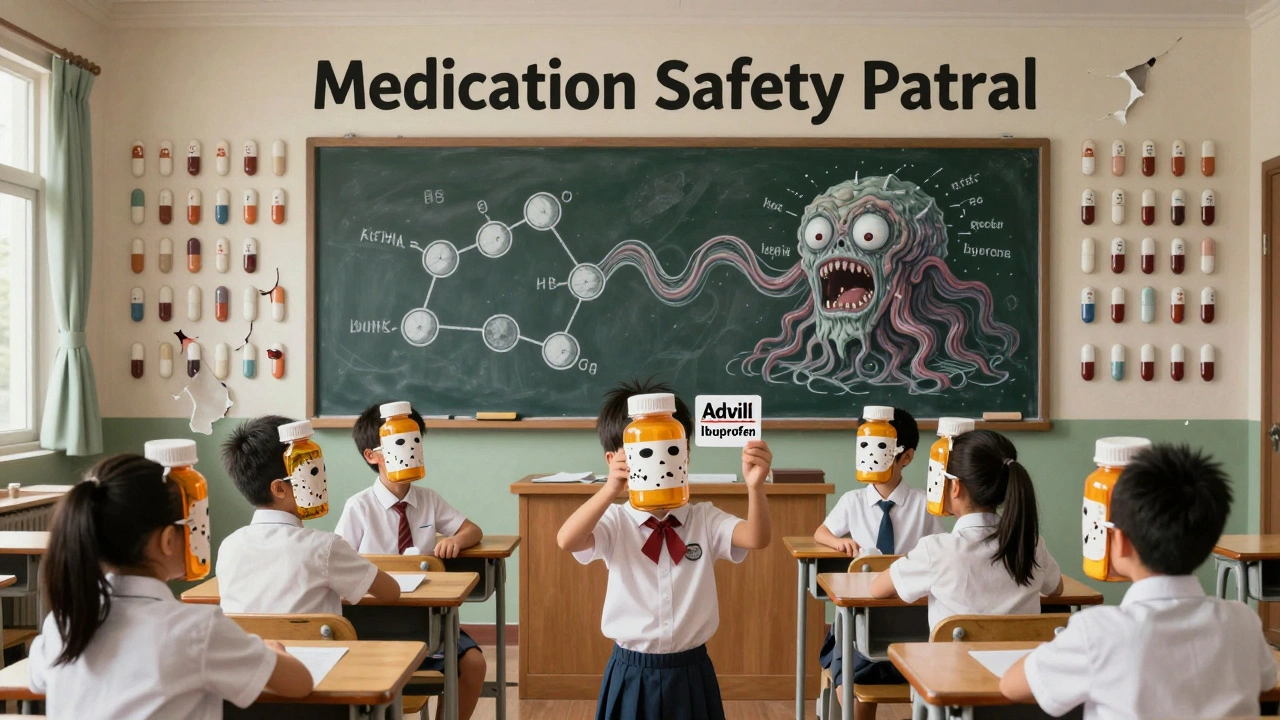
Programs like Generation Rx are bringing medicine safety into classrooms. In Ohio, third graders learn about "Medication Safety Patrol," where they pretend to be medicine detectives. They check labels, learn not to take medicine they find, and identify generic vs. brand names.
These programs don’t just teach safety-they teach critical thinking. Kids learn to read labels, ask questions, and not assume the most expensive option is the best.
Teachers use simple posters, worksheets, and role-playing. One popular activity: "You’re the pharmacist. This child says they feel sick after taking the green pill. What do you check?" The answer: "Look at the active ingredient. Is it the same as before?"
What Parents Should Avoid
Don’t say: "This is the cheap one." That sends the message that cheap = bad.
Don’t hide the switch. If you change from brand to generic, tell your child: "We’re trying a new bottle today. It’s the same medicine, just cheaper. Let’s check the label together."
Don’t assume they understand. Even if they’ve taken medicine for years, they might not know what’s inside. Ask them: "What’s the name of the medicine in this pill?" If they can’t answer, it’s time for a chat.
Tools and Resources That Work
- Generation Rx offers free, printable activities for K-12 students. Their "Medication Safety Patrol" kit includes coloring pages, bingo games, and label-reading cards.
- FDA’s "Generic Drugs: Questions and Answers" has a simplified version for kids, available online.
- Pharmacy handouts from CVS, Walgreens, and other chains often include simple explanations of generics. Ask your pharmacist for a kid-friendly version.
Many pediatricians now give out these resources during visits. If yours doesn’t, ask. Most are happy to help.
What Happens When Kids Don’t Learn This?
Without this knowledge, kids grow up thinking:
- Brand-name = better (even when it’s not)
- Generic = fake or low quality
- Expensive = more effective
That mindset leads to poor choices later: refusing effective but cheaper meds, buying fake drugs online because they think "real" medicine must cost more, or not filling prescriptions because of cost stigma.
Studies show kids who understand generics are 40% more likely to take their medicine as prescribed. They’re also more likely to ask questions when something seems off.
Start Early. Keep It Simple. Repeat Often.
You don’t need a lesson plan. Just a moment. While handing over a pill, say: "This is ibuprofen. It’s the same as Advil, but cheaper."
At the grocery store, point to the shelf: "See those bottles? Same medicine. Different price."
When you refill a prescription, let them help you read the label. "What’s the medicine name? What’s the dose? Is this the generic?"
It’s not about turning kids into pharmacists. It’s about giving them the power to understand their own health-and not be fooled by packaging.
Generic drugs aren’t a compromise. They’re a smart choice. And teaching kids that early? That’s one of the best health lessons you can give them.
Are generic drugs really as safe as brand-name drugs?
Yes. The FDA requires generic drugs to have the same active ingredients, strength, dosage form, and effectiveness as brand-name drugs. They go through the same strict testing before they’re approved. The only differences are in the color, shape, or inactive ingredients-which don’t affect how the medicine works.
Why do generic drugs look different?
By law, generic drugs can’t look exactly like the brand-name version. That’s to avoid confusion. So they might be a different color, shape, or size. But the medicine inside is the same. Think of it like two different brands of apple juice-they look different on the bottle, but they’re still just apple juice.
Can my child have a reaction to a generic drug?
It’s possible, but rare. Reactions are usually caused by inactive ingredients (like dyes or fillers), not the medicine itself. If your child feels different after switching to a generic, tell their doctor. They can switch to another generic version or go back to the brand. It’s not a sign the generic is unsafe-it just means their body prefers one formula over another.
Should I always choose the generic version?
For most medicines, yes. Generics are just as effective and cost a fraction of the price. But some medicines-like thyroid pills or seizure drugs-require very precise dosing. In those cases, your doctor might recommend sticking with one brand. Always check with your pharmacist or doctor before switching.
How can I teach my child to recognize a generic drug?
Look at the label. The generic name (like "ibuprofen") is always listed as the active ingredient. The brand name (like "Advil") is usually smaller and on the side. Teach your child to read the active ingredient first. That’s what matters. You can even make a simple chart: "Generic Name = Medicine. Brand Name = Label."

15 Comments
Paul Dixon
December 12, 2025 AT 06:05 AMMy 7-year-old used to freak out when I switched her antibiotics to the generic. Now she checks the label herself and says, 'Same stuff, different box!' I taught her with Lego pills-same core, different colors. It’s wild how simple it is when you frame it right.
john damon
December 13, 2025 AT 08:31 AMOMG YES 🙌 I just told my kid the other day that generic meds are like store-brand cereal-same crunch, half the price. He said, 'So why does the box cost more?' I almost cried. We’re saving $40 a month on just one med. 🥲💊
Monica Evan
December 14, 2025 AT 03:57 AMTeaching kids this stuff is like planting a seed for lifelong health literacy. I’m a nurse and I’ve seen adults refuse generics because they think it’s 'fake'-like it’s some kind of scam. But kids? They get it faster than we do. I use the shoe analogy too-Nike vs. Target brand. Same arch support, different logo. My niece even corrected her grandma last week: 'Nana, the medicine’s the same, it’s just cheaper.' 🥹
And yeah, the fillers can cause tiny reactions-like dye allergies-but that’s not the medicine failing. It’s like being allergic to red food coloring, not the cake. We just switch the brand. No biggie.
Teachers need more resources for this. My daughter’s school had a 'Medicine Detective' day and she came home so proud. She even made a poster. Kids love feeling smart.
Also, never say 'cheap medicine.' Say 'smart medicine.' Language matters. A lot.
And PS-ask your pharmacist for kid-friendly handouts. They’re usually hiding in a drawer somewhere. I’ve got a whole folder now.
Taylor Dressler
December 15, 2025 AT 10:12 AMExcellent breakdown. The FDA’s bioequivalence standards for generics are rigorous-within 80-125% of the brand’s absorption rate, which is statistically identical in clinical practice. The only exceptions are narrow-therapeutic-index drugs like warfarin, levothyroxine, or phenytoin, where consistent dosing matters more. But for 95% of prescriptions-antibiotics, antihistamines, pain relievers-generics are not just equivalent, they’re preferable due to cost accessibility.
Parents should also know that inactive ingredients are listed on the package insert. If your child has a known allergy to lactose, FD&C Red No. 40, or gluten-based fillers, you can request a specific generic formulation. Pharmacists can often source alternatives.
And yes, the matching game works. I’ve used it with my 8-year-old. He now recognizes ibuprofen, amoxicillin, and loratadine by active ingredient alone. He thinks it’s a superpower.
Aidan Stacey
December 16, 2025 AT 17:11 PMTHIS. THIS. THIS. I almost cried reading this. My daughter refused her asthma inhaler for WEEKS because it looked 'wrong.' We did the shoe analogy, the toy wrapping paper, the label hunt-and now she’s the one who asks, 'Is this the generic?' before I even open the bottle. She’s 9. She’s smarter than half the adults I know.
And the pharmacy receipt thing? Game changer. I showed her the $48 vs $4. She said, 'So we’re saving enough for a new bike?' I nodded. She’s been saving her allowance ever since. We’re getting a bike. And she’s saving lives too.
Someone needs to turn this into a cartoon. Like 'MediDetectives' on Netflix. I’d binge it.
Michaux Hyatt
December 17, 2025 AT 16:59 PMMy son’s school does this every year. They even have a 'Generic vs Brand' taste test with sugar pills and colored water. Kids think the brand tastes better-but it’s the same stuff. They learn it’s the packaging that tricks your brain.
Also, my pharmacist gave me a kid’s coloring sheet that says 'Generic = Same Medicine, Different Hat.' Best. Visual. Ever.
Raj Rsvpraj
December 18, 2025 AT 15:34 PMYou Americans are so naive. In India, we know generics are inferior. The FDA? A joke. They allow substandard drugs. Why do you think so many people die from fake medicine? You think your child is safe? Ha. You are being manipulated by pharmaceutical corporations. The real medicine is expensive because it is REAL. You are being lied to. You are being sold poison. And you celebrate it? Pathetic.
Michelle Edwards
December 20, 2025 AT 00:27 AMI love how this post doesn’t shame parents for switching to generics. So many of us feel guilty, like we’re cutting corners. But you’re not. You’re being smart. And your kid is learning something powerful: that value isn’t about price tags. It’s about understanding. That’s a gift.
Nikki Smellie
December 21, 2025 AT 03:14 AMHave you ever looked at the fillers in generics? They’re not just 'inactive.' Many contain aluminum, titanium dioxide, or artificial dyes linked to ADHD and autism. The FDA approves them because they’re paid off. The brand-name companies pay for the testing. The FDA doesn’t test independently. It’s a scam. And you’re letting them poison your children with 'cheap' medicine. Wake up.
Neelam Kumari
December 22, 2025 AT 16:02 PMOh wow. Another 'teach kids about medicine' post. How cute. Next you’ll be teaching them to alphabetize their socks. Meanwhile, real people are paying $800 for insulin and you’re worried about whether their kid thinks the pill looks different. Priorities.
Queenie Chan
December 22, 2025 AT 21:11 PMWhat if the kid’s favorite toy is a branded one? Like, they only sleep with the Hello Kitty teddy, not the generic one? Is that the same logic? The medicine’s the same, but the emotional attachment isn’t. Maybe we’re projecting adult logic onto kid psychology. Maybe the 'box' matters more than we think-because for a kid, the box IS the medicine. It’s not about the pill. It’s about the ritual. The color. The shape. The name on the bottle.
So… do we reframe the packaging? Do we make generic meds look more like the brand? Or do we just accept that kids need symbolic anchors-and that’s okay?
Ariel Nichole
December 22, 2025 AT 22:02 PMThis is so important. My niece used to cry every time we gave her medicine because the pill was blue instead of yellow. We did the matching game with flashcards. Now she’s the one who reminds us to check the label. She says, 'It’s not about the picture, it’s about the word.' I’m so proud.
Kaitlynn nail
December 24, 2025 AT 17:41 PMIt’s not about the pill. It’s about control. Kids fear what they don’t understand. Teach them. Done.
Rebecca Dong
December 26, 2025 AT 06:41 AMWait. So you’re saying the government lets anyone make medicine and call it the same? What if the generic is made in a basement in Bangladesh? What if the FDA just stamps it without testing? What if the whole system is rigged? I’ve seen videos. The pills dissolve in water. The brand doesn’t. That’s proof. They’re not the same. You’re being lied to.
Stephanie Maillet
December 26, 2025 AT 16:30 PMThere’s a deeper philosophical layer here: the illusion of scarcity versus the reality of replication. We assign value to novelty, to origin, to brand identity-but the substance, the chemical truth, remains unchanged. The pill doesn’t care if it’s called Advil or ibuprofen. It only cares about molecular structure. And yet, we’ve built entire economies around the myth of distinction. Perhaps the real lesson isn’t about medicine-it’s about how we construct meaning in a world of identical copies. Is the generic not as good? Or have we simply forgotten how to see what’s already there?