| Scenario | Risk Level | Typical Outcome |
|---|---|---|
| Normal Renal Arteries | Low | Effective blood pressure control |
| Unilateral Stenosis (One kidney affected) | Moderate/Low | Usually tolerated with monitoring |
| Bilateral Stenosis (Both kidneys affected) | High | Potential for acute renal failure |
The Balancing Act Inside Your Kidneys
To understand why this happens, we have to look at how the kidney manages pressure. Your kidneys act like a high-pressure filtration system. To filter waste out of your blood, the pressure inside the glomerular capillaries needs to stay high. When you have Renal Artery Stenosis, which is a narrowing of the arteries that carry blood to the kidneys, the blood flow drops. This creates a crisis: if the pressure drops too low, the kidney stops filtering entirely. To fight this, the body releases renin, which eventually produces Angiotensin II. Think of Angiotensin II as a specialized valve. It constricts the efferent arteriole-the exit pipe of the filter. By narrowing the exit, the blood "backs up" inside the filter, artificially hiking the pressure back up so the kidney can keep working despite the narrow intake pipe. It's a survival mechanism that keeps the glomerular filtration rate (GFR) stable.What Happens When You Block the Valve?
When you introduce an ACE inhibitor like lisinopril or ramipril, you stop the production of Angiotensin II. Suddenly, that "exit valve" swings wide open. Because the intake pipe is already narrowed by stenosis and the exit pipe is now dilated, the pressure inside the kidney crashes. Research using micropuncture studies has shown that in healthy kidneys, Angiotensin II only slightly affects resistance. But in stenotic kidneys, it increases resistance by about 37.5% to maintain pressure. When you block this, the intraglomerular pressure can drop by 25-30%. In a patient with stenosis in both kidneys (bilateral) or only one working kidney, there is no "backup" kidney to take over the load. The result is an abrupt decline in GFR, often manifesting as a 30% or more increase in serum creatinine within a week or two of starting the drug.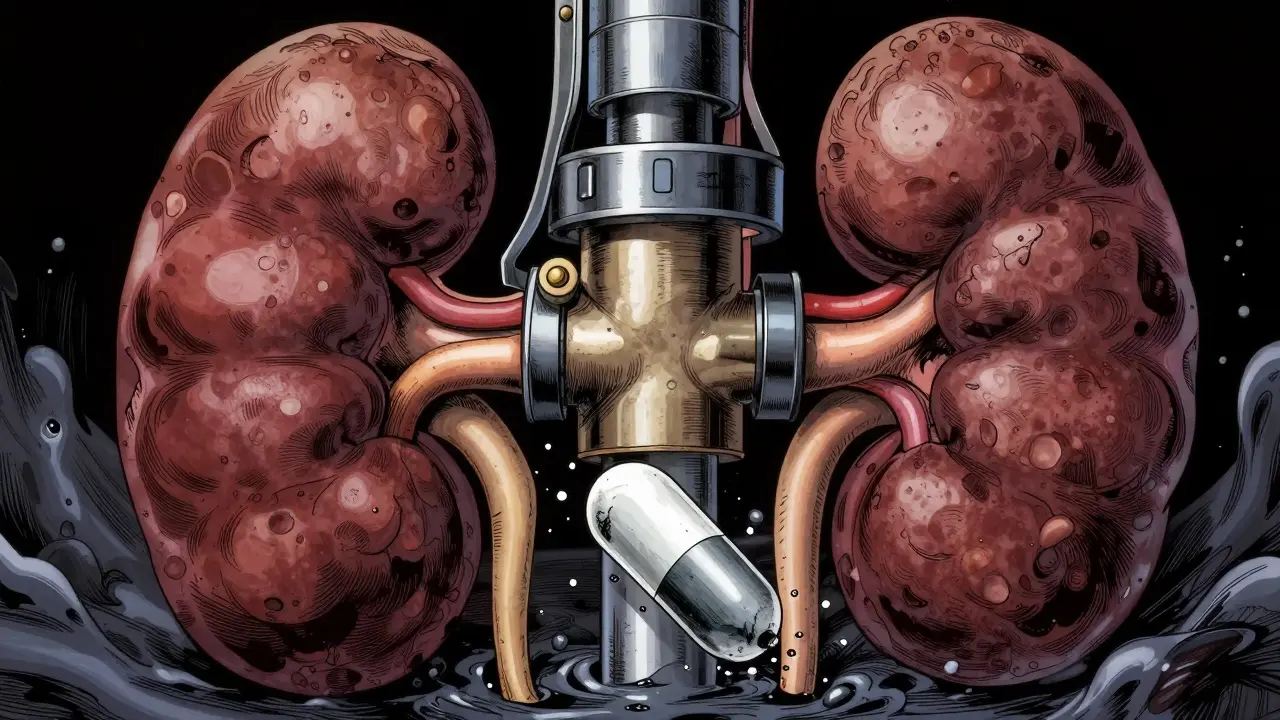
Bilateral vs. Unilateral: Why the Difference Matters?
Not everyone with a narrowed renal artery needs to avoid these drugs. The danger depends entirely on whether you have a healthy kidney to lean on. If you have unilateral renal artery stenosis (only one side is narrowed), the healthy kidney usually compensates. The stenotic kidney might struggle, but the other one keeps the body's overall waste filtration stable. Clinical data, including follow-up from the ASTRAL trial, shows that people with unilateral stenosis don't see a significant difference in kidney decline compared to those without stenosis. However, if both arteries are narrowed (bilateral) or you have a single functioning kidney with stenosis, you are in the danger zone. In these cases, the drug removes the only mechanism keeping both filters running. This isn't just a theoretical risk; retrospective studies have found that nearly 19% of patients with undiagnosed bilateral stenosis developed acute kidney injury after starting ACE inhibitors.Spotting the Warning Signs
Since renal artery stenosis is often "silent" and doesn't have obvious symptoms, doctors rely on a few red flags to decide if a patient needs screening before starting medication. You should be particularly cautious if you have:- Accelerated Hypertension: Blood pressure that spikes suddenly or is incredibly difficult to control with multiple meds.
- Unexplained Renal Impairment: A slow or sudden decline in kidney function without a clear cause like diabetes.
- Abdominal Bruits: A "whooshing" sound that a doctor hears through a stethoscope over the renal arteries, indicating turbulent blood flow through a narrow opening.

Can You Switch to ARBs Instead?
There is a common misconception that if an ACE inhibitor is too risky, an Angiotensin Receptor Blocker (ARB) (like losartan or valsartan) is a safe alternative. This is a dangerous mistake. ARBs work on the same pathway; they don't stop the production of Angiotensin II, but they block the receptors that the hormone uses to do its job. The end result is exactly the same: the "exit valve" opens, the pressure drops, and the kidney fails. Major guidelines, including the KDIGO clinical practice guidelines, explicitly state that ARBs are not an appropriate substitute for patients with bilateral renal artery stenosis.How to Safely Monitor Kidney Function
For patients where ACE inhibitors are still appropriate but there's some risk, monitoring is key. The National Institute for Health and Care Excellence (NICE) suggests a strict timeline for blood tests. You shouldn't just get a baseline test and assume everything is fine.- Pre-start: Check renal function and potassium levels.
- The 10-Day Mark: Repeat blood tests approximately 10 days after starting the medication or after any dose increase. This is when the acute drop in GFR typically manifests.
- Creatinine Check: If serum creatinine increases by more than 30%, the drug should be evaluated, and the patient should be screened for bilateral stenosis.
Can I take an ACE inhibitor if only one of my renal arteries is narrowed?
Generally, yes. In unilateral renal artery stenosis, the other healthy kidney usually maintains the body's overall filtration rate. However, your doctor will still likely monitor your creatinine levels closely to ensure your kidney function remains stable.
What is the most common sign that an ACE inhibitor is causing kidney issues?
The primary indicator is a sudden rise in serum creatinine-typically an increase of 30% or more-within 7 to 14 days after starting the medication. This reflects a drop in the glomerular filtration rate (GFR).
Are ARBs a safe alternative for people with bilateral renal artery stenosis?
No. ARBs (Angiotensin Receptor Blockers) block the action of Angiotensin II just as ACE inhibitors stop its production. This leads to the same drop in intraglomerular pressure and carries the same risk of acute renal failure in patients with bilateral stenosis.
Is the kidney damage caused by these meds permanent?
In most cases, the deterioration is reversible if the medication is stopped promptly. However, if the kidney suffers from severe hypoperfusion for more than 72 hours, there is a risk of permanent damage.
How do doctors test for renal artery stenosis before prescribing?
The most common first step is a renal artery duplex ultrasound. It is non-invasive and highly effective at detecting significant narrowing of the arteries. In some cases, CT angiography or MRA may be used for more detail.





13 Comments
Akshata Kembhavi
April 20, 2026 AT 08:27 AMSuper helpful breakdown of how these meds actually work in the body.
Lynn Smith
April 22, 2026 AT 04:43 AMI totally agree that the explanation about the exit valve is so easy to visualize! It really helps make the medical jargon feel way more approachable for everyone.
Cynthia Didion
April 23, 2026 AT 15:31 PMBasic pharmacology. Only a novice would be surprised by this.
dallia alaba
April 24, 2026 AT 00:11 AMIt is crucial to highlight that the 10-day blood test isn't just a suggestion, but a safety necessity. Many patients forget this part, and by the time they realize their creatinine is spiking, they've already lost significant nephron function. In clinical practice, we often see people who think they are just "adjusting" to the med, but actually, they're in acute renal failure. It's all about that glomerular pressure balance. If you're on lisinopril and you suddenly feel fatigued or notice decreased urine output, don't wait for the next appointment. Get your labs done immediately. Also, keep in mind that dehydration-like from a stomach bug-can exacerbate this drop in pressure even further, making ACE inhibitors even more dangerous during an illness. This is why the 'sick day rules' for these medications are so vital. We need to be proactive about screening for bruits in patients with resistant hypertension because that's often the only clue we get before the drug causes a crash. The duplex ultrasound is a great first step, but don't hesitate to push for a CT angio if the ultrasound is inconclusive. Proper monitoring is the only way to use these drugs safely in high-risk populations. Always verify the bilateral status before committing to long-term therapy. Education is the best prevention here. Let's make sure patients know why the blood test matters.
Arthur Luke
April 24, 2026 AT 09:15 AMI've always wondered if there's a specific threshold of stenosis where the risk becomes unacceptable. It seems like a very fine line between therapeutic benefit and actual harm.
Bob Collins
April 24, 2026 AT 16:03 PMSpot on. Just keep an eye on those labs and you'll be fine.
Ms. Sara
April 24, 2026 AT 17:52 PMWe really need to emphasize that the ARB switch is a trap. People assume a different drug name means a different mechanism, but the blockade of Angiotensin II effect is what matters here.
Valorie Darling
April 25, 2026 AT 10:29 AMlol imagine thinking your doctor actually checks your creatinine on time most of them just prescribe and pray hope you guys dont end up on dialysis bc your doc is lazy
Lesley Wimbush
April 26, 2026 AT 15:26 PMOh honey, the drama of a lazy doctor is so real! But really, it's just basic medical literacy that's missing in this country.
Venkatesh Venky
April 28, 2026 AT 03:36 AMThe GFR drop is quite scary but the renin-angiotensin-aldosterone system is just doing its job to save the organs. Let's just stay positive and follow the guidelines!
julya tassi
April 29, 2026 AT 00:12 AMThis is so interesting! I never knew about the "whooshing" sound! 😮 Thanks for sharing this info!
anne camba
April 29, 2026 AT 16:46 PMThe fragility of the human filter... so strange... how a tiny molecule can shift the balance of life and death...!!
William Young
April 30, 2026 AT 16:23 PMIt's important to remain calm and just follow the monitoring schedule as described. Patience and a few blood tests can save a lot of trouble.