Amiodarone-Digoxin-Warfarin Interaction Checker
Safe Dose Adjustment Calculator
Imagine taking three common heart medications-each one prescribed for a serious condition-and not realizing they’re working together to push your body toward a life-threatening crisis. This isn’t hypothetical. It’s happening every day in hospitals and homes across the U.S. and the U.K., especially in older adults with atrial fibrillation. The combination of amiodarone, digoxin, and warfarin is one of the most dangerous drug triads in modern cardiology. And yet, it’s still prescribed far too often without proper safeguards.
Why This Triad Is So Risky
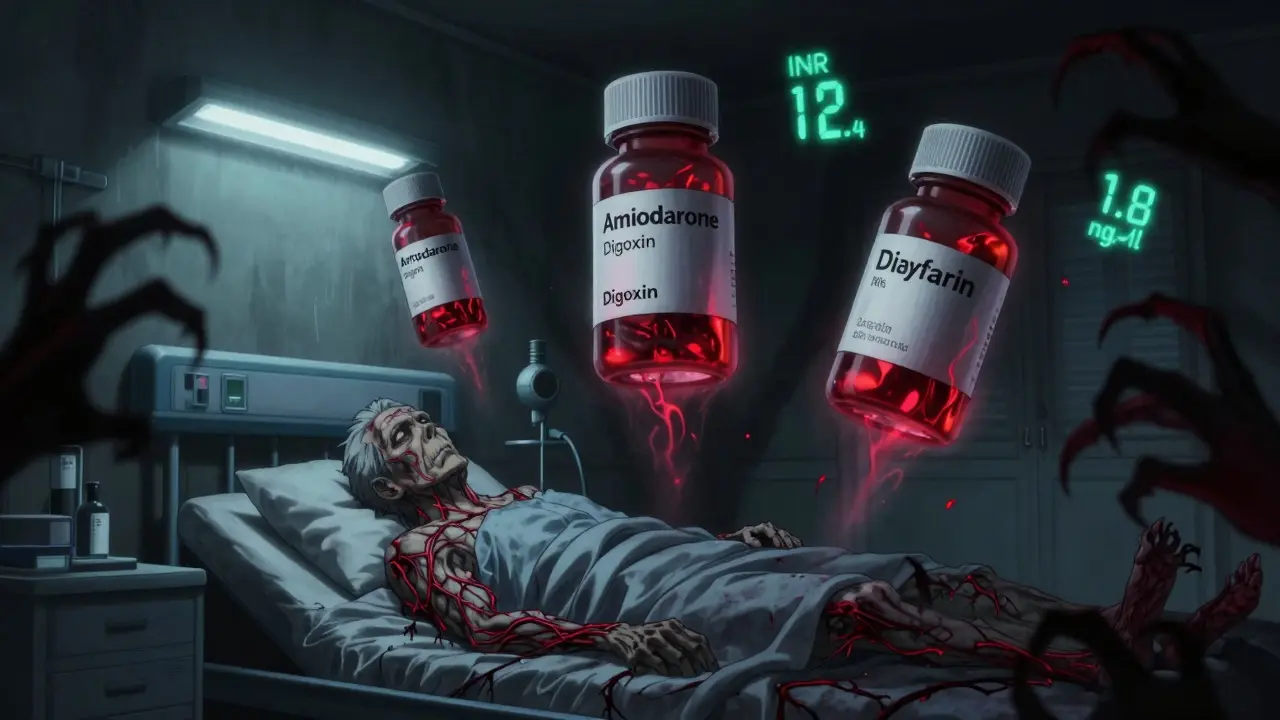
Amiodarone is a powerful antiarrhythmic used to treat irregular heartbeats like atrial fibrillation and ventricular tachycardia. Digoxin helps control heart rate in those same patients. Warfarin prevents dangerous blood clots. Individually, each drug has known risks. Together, they create a perfect storm. The problem starts with how amiodarone interferes with the way your body processes the other two drugs. Amiodarone doesn’t just interact with digoxin and warfarin-it amplifies their effects in ways that are hard to predict and even harder to reverse. For digoxin, amiodarone blocks a key transporter called P-glycoprotein. This transporter normally helps your kidneys and liver remove digoxin from your bloodstream. When it’s blocked, digoxin builds up. Studies show serum levels can spike by 40% to 100% within just a few days of starting amiodarone. That’s not a small change. Digoxin has a very narrow safety window. Levels above 1.2 ng/mL in elderly patients are considered toxic. At those levels, you might start feeling nauseous, dizzy, or see halos around lights. Then comes the real danger: life-threatening arrhythmias, including ventricular tachycardia. Meanwhile, amiodarone shuts down the liver enzymes-CYP2C9 and CYP3A4-that break down warfarin. S-warfarin, the more potent form, sees its clearance drop by 55%. That means your blood thins much more than expected. INR levels that were stable at 2.5 can jump to over 6 or even 10 within two weeks. That’s not just an elevated number-it’s a red flag for major bleeding. Intracranial hemorrhage, gastrointestinal bleeds, even fatal bruising from minor falls become real risks. And here’s the kicker: amiodarone stays in your system for months. Its half-life is 25 to 100 days. So even if you stop taking it, the interaction doesn’t go away. You can’t just flip a switch and expect everything to return to normal.What Happens When This Triad Goes Wrong
Real-world data tells a chilling story. Between 2010 and 2022, over 1,800 adverse event reports to the FDA involved digoxin toxicity linked to amiodarone. That’s a 5.3 times higher risk than digoxin alone. In one 2020 study of nearly 13,000 patients on warfarin, those also taking amiodarone had more than a threefold increase in INR levels above 4.0-and an 180% higher chance of major bleeding. One case from Massachusetts General Hospital involved a 78-year-old man whose INR hit 12.4 after just 10 days on amiodarone. He was rushed to the ER with internal bleeding. He needed four units of fresh frozen plasma and 5 mg of intravenous vitamin K to survive. That’s not an outlier. It’s a textbook example. The 2021 Circulation: Arrhythmia and Electrophysiology review found that patients on both amiodarone and digoxin had a 28% higher risk of death compared to those on digoxin alone. The highest risk? The first 30 days after starting amiodarone. That’s when most of the damage happens-and when most clinicians are still waiting for lab results to catch up.How to Manage This Triad Safely
If you or someone you care for is on this combination, don’t panic-but don’t ignore it either. There are proven steps to reduce risk. First, if amiodarone is being added to a regimen that already includes digoxin and warfarin, the guidelines are clear:- Reduce the digoxin dose by 50% immediately-don’t wait for lab results.
- Check serum digoxin levels 72 hours after starting amiodarone, then weekly until stable.
- Lower the warfarin dose by 30-50% before or at the same time you start amiodarone.
- Test INR every 48 to 72 hours for the first two weeks, then weekly for at least a month.
- Keep monitoring INR for 4 to 6 weeks after stopping amiodarone. The drug’s long half-life means the interaction lingers.
What About Newer Drugs?
The good news? Direct oral anticoagulants (DOACs) like apixaban, rivaroxaban, and dabigatran are now used in 82% of new atrial fibrillation cases. They don’t require INR monitoring and have fewer interactions than warfarin. But here’s the catch: amiodarone still affects DOACs. It inhibits P-glycoprotein, which is how drugs like dabigatran are cleared. So even if you switch from warfarin, you still need caution with digoxin and amiodarone. And for patients with mechanical heart valves? Warfarin is still the only approved option. So for millions of people-especially those over 75-this triad isn’t going away anytime soon.Red Flags to Watch For
If you’re on this combination, know the warning signs:- For digoxin toxicity: nausea, vomiting, blurred vision, yellow-green halos, new palpitations, or dizziness.
- For warfarin over-anticoagulation: unusual bruising, nosebleeds, blood in urine or stool, severe headaches, or weakness on one side of the body.
Why This Still Happens
You might wonder: if this is so well-documented, why are people still getting hurt? One reason is fragmentation. A cardiologist prescribes amiodarone. A primary care doctor manages warfarin. A pharmacist handles digoxin refills. No one sees the full picture. Another is complacency. Many assume that because these drugs have been used for decades, they’re safe. But safety isn’t about history-it’s about pharmacology. And the pharmacology here is brutal. Electronic health record alerts help-studies show they reduce errors by 65%. But they’re not foolproof. If the system doesn’t flag the interaction, or if the clinician clicks past it, the risk remains.What You Can Do
If you’re taking any of these three drugs:- Ask your doctor: “Are we monitoring digoxin levels and INR closely since I started amiodarone?”
- Request a medication review with your pharmacist-especially if you take more than five drugs.
- Keep a written log of symptoms: when you feel sick, what you ate, your heart rate, any bruising.
- Never skip an INR test, even if you feel fine.
Is There a Better Way?
For some, yes. Newer antiarrhythmics like dronedarone or flecainide may be safer alternatives to amiodarone-though they come with their own restrictions. For anticoagulation, DOACs are now preferred for most patients without mechanical valves. But for those who need amiodarone-for recurrent ventricular tachycardia, for example-the combination with digoxin and warfarin may still be unavoidable. That’s why the focus must be on control, not avoidance. The bottom line: this triad isn’t a myth. It’s a medical reality. And the only way to survive it is to understand it-and manage it with discipline, not luck.Can amiodarone and digoxin be taken together safely?
Yes, but only with strict monitoring and dose adjustments. Amiodarone increases digoxin levels by 40-100%, so the digoxin dose must be reduced by at least 50% when starting amiodarone. Serum digoxin levels should be checked within 72 hours and monitored weekly until stable. Levels above 1.2 ng/mL in older adults indicate toxicity risk.
How long does the interaction between amiodarone and warfarin last?
The interaction lasts for weeks to months after stopping amiodarone because the drug has an extremely long half-life-25 to 100 days. Warfarin dose reductions should continue for 2-4 weeks after amiodarone is discontinued, and INR should be monitored for at least 4-6 weeks. Stopping amiodarone doesn’t mean the risk disappears.
Is warfarin still used with amiodarone, or are DOACs better?
DOACs like apixaban and rivaroxaban are now preferred for most new atrial fibrillation patients because they don’t require frequent blood tests and have fewer interactions. However, amiodarone still affects DOACs by inhibiting P-glycoprotein, so caution is still needed. Warfarin remains necessary for patients with mechanical heart valves or severe kidney disease, so the triad still occurs in 4.3 million Americans through 2030.
What should I do if I start feeling dizzy or nauseous while on these drugs?
Don’t wait. Contact your doctor immediately. Dizziness, nausea, vomiting, or visual changes could signal digoxin toxicity. Bruising, nosebleeds, or dark stools may mean warfarin is too strong. Both are medical emergencies. Get your digoxin level and INR checked right away-even if you think it’s "just a stomach bug."
Can a pharmacist help me manage this drug combination?
Yes. Pharmacists are trained to spot dangerous interactions. Ask for a comprehensive medication review, especially if you take five or more drugs. Many pharmacies now offer free medication therapy management services. They can flag when your digoxin or warfarin doses need adjustment and remind you when to get blood tests.





14 Comments
Catherine Scutt
January 9, 2026 AT 10:21 AMI swear, my grandma was on this combo and no one told her anything. She ended up in the ER with bleeding gums and seeing yellow halos. They didn't even check her digoxin levels for weeks. This needs to be screamed from the rooftops.
Darren McGuff
January 9, 2026 AT 13:16 PMI've seen this play out in the NHS more times than I can count. A 79-year-old man on warfarin for AFib, gets amiodarone for his VT, and boom - INR hits 11. No one connects the dots until he's bleeding into his gut. The system is broken. We're treating drugs like they're harmless candies.
And yes - the 50% digoxin reduction? Non-negotiable. I've lost patients because someone thought 'it'll be fine.' It's not.
Chris Kauwe
January 11, 2026 AT 12:36 PMThis is why America needs to stop outsourcing medical decisions to algorithms. EHRs flag this? Sure. But the doc clicks past it because they're rushing between 30 patients. Meanwhile, the patient's liver is slowly committing suicide. We don't need more apps - we need doctors who remember pharmacology. This triad is a war crime disguised as standard care.
Jerian Lewis
January 11, 2026 AT 14:34 PMPeople think if it's on the label, it's safe. Nope. Warfarin's been around since 1954. Digoxin since 1785. Amiodarone since 1962. Just because it's old doesn't mean it's not dangerous. You wouldn't drive a 1950s car without seatbelts - why treat meds like that?
Kiruthiga Udayakumar
January 11, 2026 AT 17:45 PMMy mom is 82 and on all three. I printed out this whole post and handed it to her cardiologist. He said "Oh, we know." But he didn't adjust her digoxin. So I did. I called the pharmacy. They lowered it. She's fine now. Don't wait for them to save you. Save yourself.
Maggie Noe
January 13, 2026 AT 00:24 AMThis is why I became a pharmacist 💔
Every time I see this combo on a script, I call the prescriber. Every. Single. Time. I don't care if they're a top cardiologist - if they didn't reduce the digoxin, they're playing Russian roulette with someone's life. I've had doctors yell at me. I've had nurses cry because their patient almost bled out.
It's not dramatic. It's data. And data doesn't lie.
Gregory Clayton
January 13, 2026 AT 13:29 PMI work in a nursing home. We had a guy on this triad. Got confused, fell, cracked his skull. INR was 9.8. He died in the OR. His family sued. The hospital settled. But no one changed the protocol. That's the real horror story - not the drugs. The system that lets this keep happening.
Johanna Baxter
January 15, 2026 AT 09:49 AMI just lost my uncle to this. He was fine one day. Then he started seeing halos. Thought it was his glasses. Went to bed. Woke up with blood in his urine. By the time they got him to the hospital, it was too late. No one warned him. No one told him to check his INR. I'm still angry. I'm still grieving. This isn't medicine. It's negligence dressed in white coats.
Elisha Muwanga
January 15, 2026 AT 20:28 PMWhile the pharmacokinetic interactions are well-documented, one must also consider the sociological implications of polypharmacy in aging populations. The fragmentation of care across specialties creates systemic blind spots that cannot be remedied by individual clinician vigilance alone. Structural reform is required.
Aron Veldhuizen
January 17, 2026 AT 18:53 PMYou're all missing the point. This isn't about dosing. It's about control. Who gets to decide what drugs a person takes? The FDA? The doctor? The algorithm? Or the patient? If we're going to talk about dangerous triads, let's start with the one that forces people to rely on three toxic drugs just to stay alive. That's the real tragedy.
Micheal Murdoch
January 18, 2026 AT 05:12 AMHey - if you're on this combo, you're not alone. And you're not broken. You're just caught in a system that hasn't caught up with science yet. But here's what you can do: write down your meds, your symptoms, your INR numbers. Bring it to your next appointment. Ask for a pharmacist consult. You've got more power than you think.
And if you're a provider? Stop clicking past the alert. Pause. Breathe. Read the damn paper. Someone's life is on the line.
Jeffrey Hu
January 19, 2026 AT 02:21 AMActually, the 50% digoxin reduction is outdated. A 2022 meta-analysis showed 60% reduction with amiodarone co-administration gives better outcomes. Also, INR checks every 48 hours? Overkill. Twice a week is sufficient unless INR >3.5. Stop following old guidelines like they're gospel.
Drew Pearlman
January 20, 2026 AT 16:11 PMI know this feels scary, but hear me out - you can still live a full life on this combo. My dad’s 84, on all three, and he still plays golf every weekend. He checks his INR religiously, takes half the digoxin, and his doctor calls him every week. It’s not about fear. It’s about discipline. And discipline beats luck every time. You’ve got this.
Lindsey Wellmann
January 21, 2026 AT 21:58 PMI just found out my mom is on this combo and I’m crying right now. I’m going to call her pharmacy. I’m going to print this out. I’m going to make sure she gets a medication review. I’m not letting her be another statistic. ❤️🩹