When someone feels down for weeks on end, it’s easy to assume they have depression. But not all depression is the same. Two very different conditions - bipolar depression and unipolar depression - look alike on the surface, but they demand completely different treatments. Getting it wrong doesn’t just delay help; it can make things worse.
What’s the Real Difference?
Unipolar depression, also called Major Depressive Disorder (MDD), means you experience only depressive episodes. No highs. No energy surges. No racing thoughts. Just persistent sadness, fatigue, trouble sleeping, and loss of interest in things you once enjoyed. It’s the kind of depression most people think of when they hear the word. Bipolar depression is different. It’s not a standalone condition - it’s one half of bipolar disorder. People with bipolar disorder swing between deep depressions and periods of mania or hypomania. Mania means extreme energy, reduced need for sleep, impulsive spending, or risky behavior. Hypomania is a milder version, but still noticeable. If you’ve ever had one of these high phases, even once, your depression is part of bipolar disorder - not unipolar. This isn’t just semantics. It’s life-changing. A 2017 study found that people misdiagnosed with unipolar depression when they actually had bipolar disorder spent an average of 8.2 more years on the wrong treatment before getting the right one.How Doctors Tell Them Apart
There’s no blood test or brain scan to tell them apart. Diagnosis relies on history, symptoms, and careful questioning. The DSM-5, the official guide used by clinicians, says both conditions require at least five depressive symptoms lasting two weeks - low mood, weight changes, insomnia, fatigue, guilt, trouble concentrating, or thoughts of death. But for bipolar depression, the clinician must also ask: Have you ever felt unusually wired, overly confident, or impulsive? Did you go days without sleep and still feel great? Did you spend money you couldn’t afford? Some symptoms are more common in bipolar depression:- Early morning waking (57% vs. 39% in unipolar)
- Severe morning worsening of mood (63% vs. 41%)
- Psychomotor slowing - moving and speaking very slowly (68% vs. 42%)
- Psychotic features like delusions or hallucinations (22% vs. 8%)
- More intense cognitive fog, like trouble remembering simple things
Why Antidepressants Can Be Dangerous
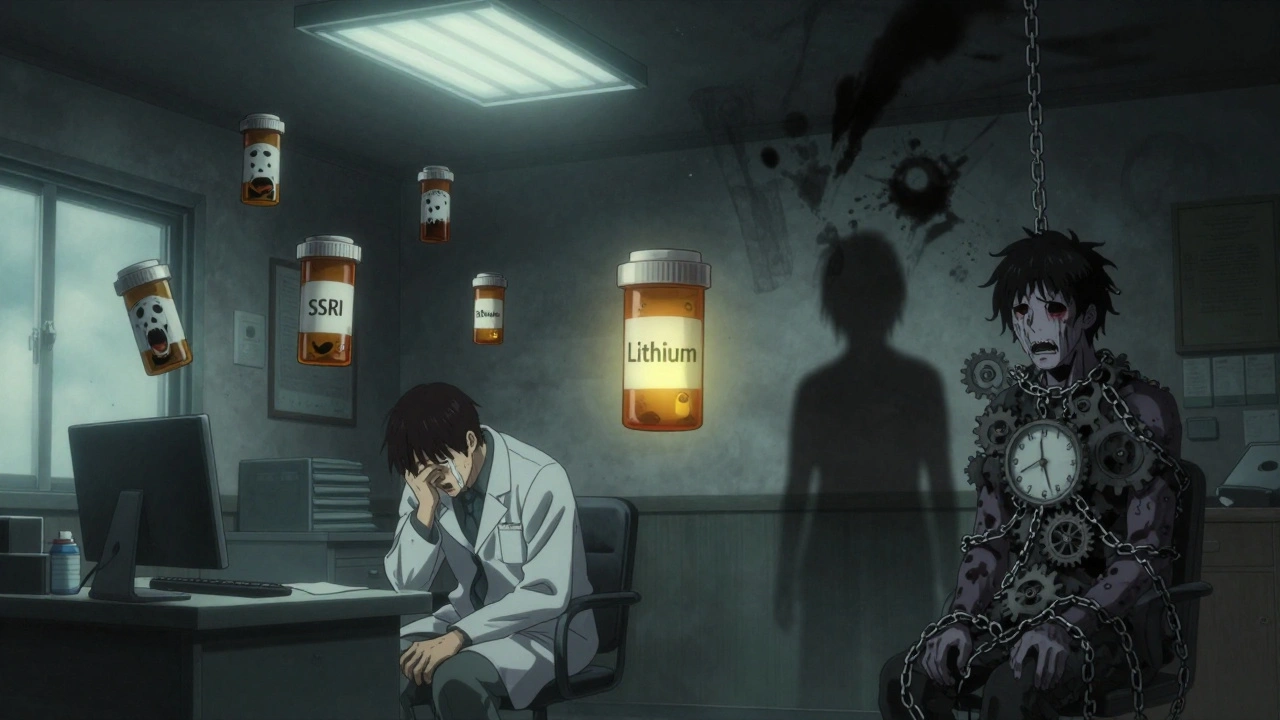
This is where things get critical. For unipolar depression, antidepressants like sertraline or escitalopram (SSRIs) are the first-line treatment. About 60-65% of people respond well after 8-12 weeks. But for bipolar depression, antidepressants alone are risky. They can trigger mania, rapid cycling (four or more mood episodes in a year), or even mixed episodes - where you feel depressed and wired at the same time. The STEP-BD study showed that 76% of bipolar patients on antidepressants without mood stabilizers experienced mood destabilization. Compare that to 38% on mood stabilizers alone. One Reddit user, u/BipolarSurvivor, shared: “I was on Prozac for 7 years. My episodes went from two a year to twelve. My doctor didn’t see the hypomania until I was hospitalized after a spending spree.” That’s not rare. The National Comorbidity Survey found that 89.7% of people with undiagnosed bipolar disorder were given antidepressants alone - and many got worse.What Actually Works for Bipolar Depression
Treatment for bipolar depression starts with mood stabilizers and atypical antipsychotics - not SSRIs.- Lithium: One of the oldest and most studied. It reduces depressive symptoms in about 48% of cases, compared to 28% for placebo.
- Quetiapine (Seroquel): Approved specifically for bipolar depression. In clinical trials, 58% of people improved, versus 36% on placebo.
- Lurasidone (Latuda): Another FDA-approved option. Works well without causing weight gain or sedation.
- Cariprazine (Vraylar): Newer, approved in 2019. Shows remission in 37% of patients at 8 weeks.
Therapy That Makes a Difference
Medication isn’t enough. Therapy helps both conditions, but the type matters. For unipolar depression, Cognitive Behavioral Therapy (CBT) focuses on changing negative thought patterns. It’s proven to reduce relapse by up to 40%. For bipolar disorder, Interpersonal and Social Rhythm Therapy (IPSRT) is more effective. It’s about structure: waking up, eating, and going to bed at the same time every day. Stability prevents mood swings. One study found that 68% of people on IPSRT stayed in remission after a year, compared to just 42% with standard care.What Happens If You Stop Treatment?
Unipolar depression: If it’s your first episode and you’ve been stable for 6-12 months, doctors may slowly taper off medication. Many people never have another episode. Bipolar disorder: Stopping treatment is risky. A 2014 meta-analysis showed that 73% of people with bipolar disorder relapsed within five years if they stopped their mood stabilizers. With continued treatment, that drops to 37%. This isn’t about being “on drugs forever.” It’s about managing a chronic condition - like diabetes or high blood pressure. You don’t stop insulin just because your sugar’s normal.When to Suspect Bipolar Disorder
You don’t need to have full-blown mania to have bipolar disorder. Hypomania is subtle. It can look like productivity, confidence, or creativity. But if it’s followed by a crash, that’s a clue. Ask yourself:- Have I ever gone days without sleep and felt great?
- Have I ever spent money recklessly and regretted it later?
- Did antidepressants make my mood worse - faster cycling, anger, or impulsivity?
- Do I have a parent or sibling with bipolar disorder?
- Have I had multiple depressive episodes, and none of the meds worked well?

The Cost of Getting It Wrong
Misdiagnosis doesn’t just hurt emotionally - it costs money. A 2021 study found that each misdiagnosed bipolar patient costs the healthcare system an extra $13,247 per year due to hospitalizations, wrong meds, and emergency visits. The global market for antidepressants is $14.6 billion. The market for bipolar treatments - mood stabilizers and antipsychotics - is nearly double at $28.7 billion. That gap reflects the complexity, and the need for accurate diagnosis.What’s Next?
Research is moving fast. A 2023 Lancet study identified a 12-gene pattern that distinguishes bipolar from unipolar depression with 83% accuracy. Smartphone apps are being tested to track sleep, speech patterns, and typing speed - tiny changes that predict mood shifts before they happen. The DSM-5-TR (2022) now includes a “with mixed features” specifier for depression. That’s a step toward recognizing that mood disorders exist on a spectrum - but the core message stays the same: treat bipolar depression like bipolar disorder. Not like unipolar.What You Can Do
If you’ve been diagnosed with depression and:- Antidepressants didn’t help - or made things worse
- You’ve had multiple depressive episodes
- You have a family history of bipolar disorder
- You’ve had periods of unusual energy, impulsivity, or reduced need for sleep
Can you have bipolar depression without ever having mania?
No. By definition, bipolar depression only occurs in people who have had at least one manic or hypomanic episode. If you’ve never had a high phase, your depression is unipolar. But many people don’t recognize hypomania - it can feel like being “on top of the world,” productive, or unusually confident. That’s why asking about past energy spikes is critical.
Are antidepressants ever used for bipolar depression?
Only as a last resort, and never alone. If a mood stabilizer or antipsychotic isn’t fully controlling the depression, a doctor might add an antidepressant - but only if the person is already stable. Even then, they’re used short-term and monitored closely. The risk of triggering mania is too high to use them as the main treatment.
How long does it take to diagnose bipolar disorder correctly?
On average, it takes 8 to 10 years. Many people see multiple doctors and try several medications before someone notices the pattern of highs and lows. This delay is why tracking your mood - even with a simple journal - can help. Note sleep, energy, spending habits, and irritability. That data gives your doctor the clues they need.
Can bipolar disorder be cured?
There’s no cure, but it’s highly manageable. With the right combination of medication, therapy, and lifestyle stability, most people live full, productive lives. The goal isn’t to eliminate all mood changes - it’s to prevent extreme highs and lows that disrupt work, relationships, and health.
Is bipolar depression more severe than unipolar depression?
Both are serious. But bipolar depression often comes with more intense symptoms - like psychomotor slowing, psychosis, and early morning waking. It also carries a higher risk of suicide, especially during mixed episodes. The real difference isn’t severity - it’s complexity. Bipolar depression requires more careful, long-term management.
What’s the biggest mistake doctors make?
Prescribing antidepressants without checking for a history of mania or hypomania. Many doctors assume depression = unipolar. But if someone has a family history of bipolar, has had multiple depressive episodes, or responded poorly to antidepressants, they should be screened for bipolar disorder - even if they’ve never had a “mania” episode.


15 Comments
Marvin Gordon
December 4, 2025 AT 23:08 PMBeen there. Got the t-shirt. Took me 7 years to get diagnosed right. I thought I was just a moody person until I started tracking my sleep and spending. Turns out I was hypomanic every spring and crashed hard in fall. My GP kept prescribing SSRIs. My mood got worse. Then I found a psych who asked about mania. Game changer.
Don't let anyone tell you it's just 'depression.' It's not. It's a whole different beast.
Lucy Kavanagh
December 5, 2025 AT 23:57 PMOf course the pharma giants want you to think it’s just depression. They make billions off SSRIs. But bipolar? That’s where the real money is - antipsychotics, lithium, the whole circus. They don’t want you to know how easy it is to miss the signs. Your doctor doesn’t even ask about sleep or spending habits. Why? Because they’re paid by the hour, not by accuracy.
And don’t get me started on the DSM. It’s a corporate document written by people who’ve never felt a real mood swing.
Michael Dioso
December 7, 2025 AT 05:33 AMLook, I’ve read the studies. I’ve seen the data. And let me tell you - antidepressants for bipolar are like putting a Band-Aid on a gunshot wound. You’re not fixing anything. You’re just making the patient think they’re getting better while their brain turns into a pinball machine.
And don’t even get me started on the fact that 89% of undiagnosed bipolar patients are given SSRIs. That’s not medical negligence. That’s systemic failure. And the system is broken because it’s profit-driven, not patient-driven.
Also, lithium is still the gold standard? Really? In 2024? We have gene panels and AI mood trackers now. We’re still using a 70-year-old salt?
Krishan Patel
December 8, 2025 AT 03:08 AMOne must question the metaphysical foundations of psychiatric classification. The DSM is a positivist illusion - a Cartesian attempt to reduce the fluidity of human affect into discrete boxes. Bipolar and unipolar are not ontological categories; they are linguistic constructs born of Western medical hegemony.
And yet, the pharmacological interventionist paradigm persists - as if serotonin is the soul’s currency. We treat the symptom, not the spirit. We quantify mood with scales while ignoring the existential void that precedes it.
Is depression a disorder? Or is it the soul’s cry against a world that demands constant productivity? The answer lies not in SSRIs, but in silence - in stillness - in the courage to stop medicating the truth.
Carole Nkosi
December 8, 2025 AT 23:23 PMThey don’t tell you that lithium is toxic if you’re not monitored. My cousin died because her doctor didn’t check her sodium levels. She was on lithium for six months. They said it was ‘natural.’ Natural? It’s a metal salt. You don’t just hand it out like aspirin.
And don’t get me started on quetiapine. Weight gain, diabetes, sedation - they call it ‘effective’ but it turns people into zombies. We’re trading one kind of suffering for another.
There’s no cure. There’s only survival. And the system is rigged against those who can’t afford specialists.
Deborah Jacobs
December 10, 2025 AT 14:51 PMI used to think my ‘productive phase’ was just being a high achiever. Turns out I was hypomanic - staying up for 72 hours, buying three laptops I didn’t need, texting my ex at 3 a.m. thinking I was ‘reconnecting.’ Then the crash? Oh man. I’d cry in the shower for hours. No energy. Couldn’t even open my email.
My therapist asked me one question: ‘Have you ever felt like you were on fire inside, then suddenly drowned?’ That’s when it clicked.
It’s not depression. It’s a rollercoaster with no seatbelt.
Juliet Morgan
December 12, 2025 AT 03:50 AMThank you for writing this. I’ve been told I’m ‘just anxious’ for years. My last doctor said ‘maybe you need more sleep.’ I cried in the parking lot. I’ve had 12 depressive episodes since I was 19. I’ve tried 7 meds. None worked until I got diagnosed with bipolar II.
Now I’m on cariprazine. I sleep. I don’t rage. I don’t spend. I’m alive. Not ‘fixed.’ But alive.
You’re not broken. You’re just misdiagnosed. Keep pushing for answers.
Stephanie Bodde
December 14, 2025 AT 00:23 AMOMG this is me 😭 I was on Lexapro for 5 years. My mania looked like ‘being a go-getter.’ I started a business, maxed out 3 cards, slept 2 hours a night. Thought I was ‘in my zone.’ Then I crashed into a pit of despair so deep I couldn’t get out of bed for 3 weeks.
My psychiatrist said, ‘You didn’t tell me about the highs.’ I didn’t know they counted. 😣
Now I’m on Vraylar and therapy. I’m okay. Not perfect. But okay. 💙
Mellissa Landrum
December 14, 2025 AT 15:50 PMThey’re hiding the truth. Bipolar is being overdiagnosed to push antipsychotics. The FDA approved all these drugs because the drug companies paid the researchers. You think lithium is safe? It’s a poison they’ve repackaged as medicine. And they call it ‘treatment.’
What if your ‘mood swings’ are just your soul rejecting a soulless world? What if you don’t need meds - you need to leave your job, your city, your toxic relationships?
They want you dependent. They don’t want you free.
Philip Kristy Wijaya
December 16, 2025 AT 12:52 PMLet’s be clear - the entire psychiatric enterprise is built on the illusion of biological determinism. There is no serotonin deficiency. There is no chemical imbalance. These are metaphors dressed in lab coats. The real cause? Capitalism. The pressure to perform. The erasure of community. The collapse of meaning.
Antidepressants are a pacifier for a society that refuses to heal itself. Lithium? A relic. Quetiapine? A chemical straitjacket.
We are not broken. We are responding.
And until we address the root - the alienation, the isolation, the exploitation - we will keep medicating symptoms while the disease festers.
William Chin
December 16, 2025 AT 14:39 PMAs a clinician with 18 years of experience, I can confirm the diagnostic delay is not due to incompetence - it is systemic. Primary care physicians are trained to treat depression as a monolith. They are not trained to ask about hypomania. They are not incentivized to spend 45 minutes on a psychiatric history.
Furthermore, the DSM-5-TR’s inclusion of ‘mixed features’ is a step forward, but it is still insufficient. We need mandatory screening tools in every primary care setting. We need insurance to cover comprehensive mood tracking apps. We need to stop treating bipolar disorder as a niche concern.
It is not a rare disease. It is a public health crisis disguised as individual pathology.
Stephanie Fiero
December 18, 2025 AT 02:03 AMMy sister was misdiagnosed for 10 years. She tried 12 meds. Lost her job. Lost her apartment. Got kicked out of her relationship because she ‘was too emotional.’
Then she found a bipolar specialist. Got on quetiapine. Started IPSRT. Now she’s a yoga teacher. Has a dog. Sleeps 8 hours.
It’s not magic. It’s structure. It’s patience. It’s finding the right person who asks the right questions.
Don’t give up. You’re not crazy. You’re just misunderstood.
Chris Brown
December 19, 2025 AT 18:50 PMIt’s ironic that the same people who dismiss psychiatric diagnosis as ‘unscientific’ are the first to claim they know what’s wrong with you. ‘Oh, you’re just moody.’ ‘You’re overreacting.’ ‘Just meditate.’
Meanwhile, the data is clear: bipolar disorder has a strong genetic component. It’s neurobiological. It’s measurable. The tools exist. The evidence is overwhelming.
Yet we still live in a culture that equates mental illness with weakness. And that’s the real epidemic.
sean whitfield
December 19, 2025 AT 23:00 PMSo you’re telling me if I feel good for a week and then cry for a month I’m bipolar? Cool. So is my dog. And my coffee machine.
They invented a disorder for people who don’t want to be normal. Now everyone’s bipolar. Even my cat has a mood journal.
Next they’ll say being sad is a genetic mutation. And we’ll all be on pills.
Meanwhile, real problems - poverty, trauma, loneliness - are ignored because it’s easier to sell a pill than change the world.
Jennifer Patrician
December 21, 2025 AT 16:01 PMThey don’t want you to know that lithium is used in batteries. That’s why it’s cheap. That’s why they push it. It’s not about healing. It’s about profit. The same companies that make lithium batteries make your mood stabilizers. The same people who profit from your suffering.
And the gene test? It’s a scam. They’re selling hope to desperate people. The 12-gene pattern? It’s not replicated in 3 out of 5 studies.
Wake up. You’re being played.