
Taking medication every day shouldn’t feel like a chore. Yet for millions of people managing chronic conditions - whether it’s high blood pressure, diabetes, or depression - it does. The problem isn’t laziness or forgetfulness. It’s that most people are trying to rely on willpower alone. And willpower runs out. That’s where behavioral tricks come in. Not magic. Not complicated science. Just smart, proven ways to turn taking your pills into something automatic - like brushing your teeth or drinking coffee in the morning.
Why Willpower Fails
You know you need to take your meds. You meant to. But then you got distracted, skipped breakfast, traveled, or just felt fine that day. So you skipped it. And then another day. And another. This isn’t rare. Nearly half of people with long-term health conditions don’t take their meds as prescribed. The National Institutes of Health says that leads to over 125,000 preventable deaths in the U.S. every year. Why? Because we’re asking the brain to do something it’s not built for: remember a task that doesn’t feel urgent, doesn’t give instant rewards, and requires constant effort. The solution? Stop relying on memory. Start relying on habits.Anchor Your Meds to an Existing Routine
Habits form when you link a new behavior to something you already do without thinking. This is called “habit stacking.” If you brush your teeth every morning and night, take your pills right after. If you eat breakfast at 7 a.m., take your meds as you sit down. If you check your phone before bed, put your pill organizer next to it. A 2020 study in Patient Preference and Adherence found that people who paired their medication with an existing daily habit improved adherence by 15.8%. Why? Because your brain doesn’t have to make a decision. It just follows the pattern. Try this: Write down one daily activity you never skip. Then write your medication next to it. Do this for a week. By day five, you’ll start doing it without reminding yourself.Use a Pill Organizer - But Not Just Any One
Pill organizers aren’t just for seniors. They’re for anyone who takes more than one pill a day. But a basic seven-day box won’t cut it if you’re taking meds at different times. Look for one with morning, afternoon, evening, and nighttime compartments. Even better - get one with a lock or alarm. Some come with Bluetooth that syncs to your phone and sends a push notification if you skip a dose. A 2021 study in the Journal of the American Geriatrics Society showed that elderly patients using a well-designed pill organizer reduced missed doses by 27%. But here’s the catch: you have to refill it weekly. Make it part of your routine. Set a Saturday night alarm: “Fill the box. Watch TV. Done.”Set Smart Reminders - Not Just Any Alerts
Your phone’s alarm app? Useless if it just goes off and you hit snooze. A 2021 meta-analysis in JMIR mHealth and uHealth found that smartphone reminders boosted adherence by 28.7% - but only when they were personalized. Don’t just set “Take meds.” Try: “Time for your blood pressure pill - you’re one step closer to feeling like yourself again.” Use apps that track your progress. Visual feedback works. Seeing a streak of 14 days in a row? That feels good. Break it? You’ll want to fix it. The American Heart Association’s 2023 guidelines recommend apps with three features: customizable timing, progress charts, and integration with your doctor’s records. If your pharmacy offers a free app, use it. If not, try Medisafe or MyTherapy. Both let you add photos of your pills and send voice reminders.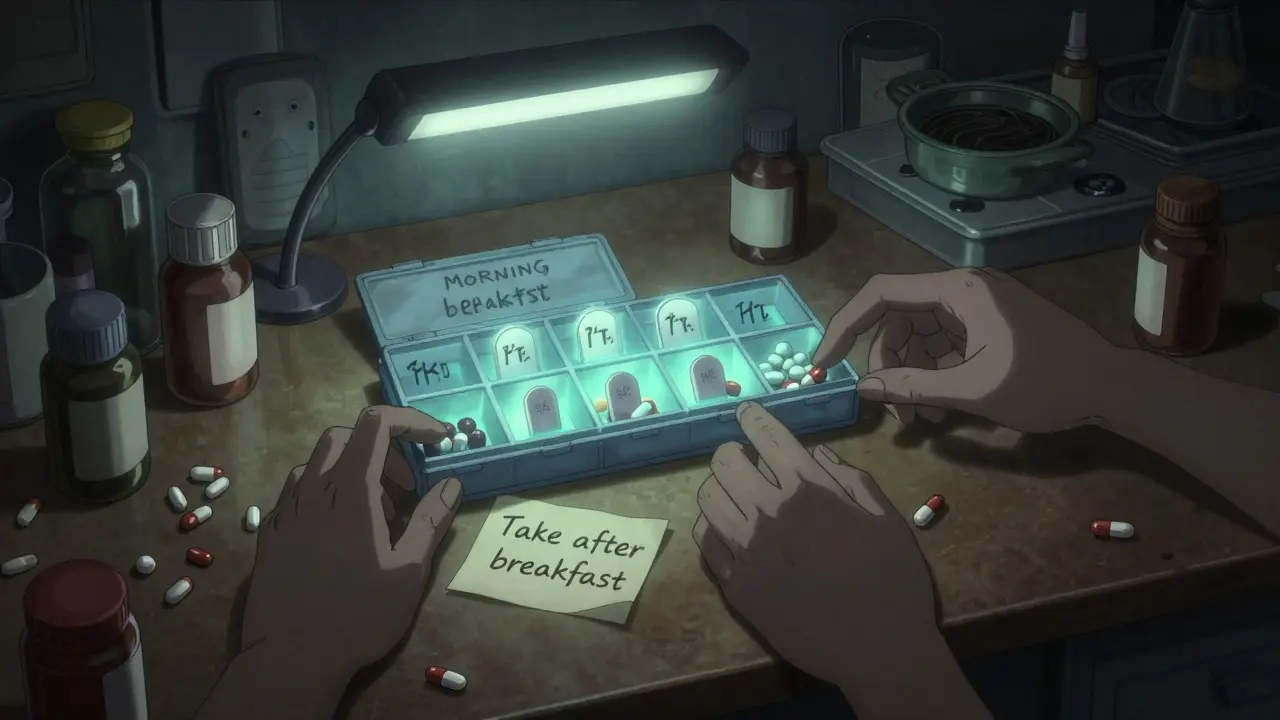
Simplify Your Regimen
The more pills you take, the harder it is to remember. That’s not your fault. It’s biology. A 2011 meta-analysis of over 21,000 patients found that switching from multiple pills to a single combination pill increased adherence by 26%. If you’re taking three separate meds for blood pressure, ask your doctor if they’re available as one pill. Even small changes help. If you’re supposed to take a pill twice a day, can it be changed to once? Many medications now come in long-acting forms. A 2022 meta-analysis in Schizophrenia Bulletin showed that long-acting injectables (LAI) reduced non-adherence by 57% in patients with serious mental illness. Don’t be afraid to ask: “Is there a simpler way to take this?” Your doctor may not have thought of it - but you’re the one who has to take it every day.Use Incentives - Not Punishments
Behavioral science shows rewards work better than guilt. So stop scolding yourself for missing a dose. Start celebrating when you get it right. Create a small reward system. Five days in a row? Treat yourself to coffee. Ten days? Buy that book you’ve been putting off. Twenty-one days? You’ve built a habit. Celebrate with something meaningful. A 2022 study in Health Affairs found that low-income patients given small financial incentives - like $5 gift cards - improved medication persistence by 34.2%. You don’t need money. Use pride. Use progress. Use a calendar with stickers.Get Support - Don’t Go It Alone
You don’t have to be the only one holding yourself accountable. Tell one person - a partner, sibling, friend - that you’re trying to build this habit. Ask them to check in once a week. Not to nag. Just to say: “How’s your pill routine going?” Team-based care works. A 2018 study in Patient Preference and Adherence found that when doctors, pharmacists, and nurses all gave the same message about adherence, patients hit 68% adherence rates - compared to 49% with scattered advice. Pharmacies offer free auto-refill programs. Sign up. It removes the stress of running out. A 2022 study showed auto-refill improved medication continuity by 33.4%.
Track It - But Not Like a Drill Sergeant
Keep a simple log. Not a spreadsheet. A sticky note. A notebook. A checkbox on your phone. Write down: “Took meds? Yes/No.” Add one line: “How did I feel today?” A 2005 study by Cochran showed that self-monitoring through daily charts increased adherence by 19.3% in bipolar patients. Why? Because awareness changes behavior. You start noticing patterns. “I always skip my afternoon pill on Wednesdays.” Now you can fix it.When You Slip Up - Don’t Quit
You’ll miss a day. Maybe two. That’s normal. The goal isn’t perfection. It’s progress. Instead of thinking, “I failed,” ask: “What got in the way?” Was it travel? A change in schedule? Stress? Then adjust. If you’re traveling, pack your meds in a small pill case with a note: “Take after breakfast.” If you’re stressed, set a reminder that says: “This pill helps you stay calm.” Behavioral change isn’t linear. It’s messy. But each time you get back on track, you strengthen the habit.What Works Best - The Evidence
Here’s what the data says about the most effective tricks:- Pairing meds with an existing habit: +15.8% adherence
- Using smartphone reminders with tracking: +28.7% adherence
- Switching to single-pill combinations: +26% adherence
- Auto-refill programs: +33.4% continuity
- Weekly pill organizers: -27% missed doses
- Financial incentives: +34.2% persistence
- Long-acting injectables: -57% non-adherence


8 Comments
Ashley Johnson
February 27, 2026 AT 03:23 AMI tried all this stuff. Then I found out my pills were being replaced with sugar pills by my insurance company. They don't want you healthy. They want you on more drugs. I started keeping the original packaging and comparing pills under a magnifying glass. You think this is about willpower? It's about corporate fraud. I've been taking photos of my pills every day since. Someone needs to investigate this.
Joanna Reyes
February 27, 2026 AT 04:43 AMI've been managing type 2 diabetes for 12 years and I can tell you that the habit-stacking method changed my life. I used to forget my metformin until I started pairing it with pouring my morning coffee - same spot, same cup, same ritual. Now I don't even think about it. I just do it. I also started using a pill box with morning/afternoon/evening slots and refill it every Sunday while watching my favorite cooking show. It's not about discipline - it's about design. Your environment should do the work for you. I've helped three friends set up their own systems and all of them now have better A1C levels. It's not magic. It's just physics. You create the conditions for success and the behavior follows.
Nerina Devi
February 27, 2026 AT 21:40 PMIn India, we don't always have access to fancy pill organizers or apps. But we have family. My mother takes her blood pressure meds every morning right after she finishes her chai. I do the same with my antidepressants - right after I finish my masala tea. It's not about technology. It's about rhythm. We have rituals that hold us together. I taught my younger sister to link her pills to brushing her teeth. She was skipping them for months. Now she hasn't missed one in 87 days. Sometimes the simplest anchors are the strongest. And yes, it works even without Bluetooth.
Dinesh Dawn
February 28, 2026 AT 19:03 PMI used to be the guy who forgot his meds every other day. Then I started using the Medisafe app with voice reminders set to my mom's voice recording. I didn't even know I had a recording of her saying 'Beta, medicine le liya?' until I found it in my phone's backup. Now every morning I hear her voice and I take it. No guilt. No pressure. Just her. I think we underestimate how much emotional connection helps. It's not just about behavior. It's about love.
Vanessa Drummond
March 1, 2026 AT 12:20 PMI tried the reward system for 3 weeks. Bought myself a new hoodie after 21 days. Then I missed two days in a row because I was too tired. I felt like trash. Then I realized: I was punishing myself for being human. So I stopped. Now I just say: 'I took it today. That's enough.' No stickers. No apps. No guilt. Just me and my pills. And that’s all I need.
Nick Hamby
March 2, 2026 AT 14:09 PMThere is a profound philosophical shift embedded in this entire framework: the transition from obligation to automation. Willpower is a finite resource, a cognitive expenditure. Habits, by contrast, are neural pathways that require no conscious deliberation. This is not merely behavioral engineering - it is epistemological liberation. When an action becomes automatic, it ceases to be a choice and becomes an expression of identity. 'I am someone who takes their medication' is not a goal - it is a state of being. The most elegant interventions are those that dissolve the tension between intention and action. We do not need more will. We need more architecture.
kirti juneja
March 4, 2026 AT 01:41 AMI started using my phone's alarm to say 'You got this, baby!' in my own voice. It sounds ridiculous - until you hear it. I also put my pill bottle in my purse next to my lipstick. Now I see it every time I reach for makeup. I'm not just taking meds - I'm doing self-care. I call it 'pill glam'. It's not clinical. It's mine. And guess what? I haven't missed one in 6 months. You don't need a spreadsheet. You need a little joy.
Haley Gumm
March 4, 2026 AT 03:18 AMYou're all missing the point. None of this works if you're on a $2000/month drug that your insurance denies. The real problem isn't your habits - it's the healthcare system. Stop blaming people for not taking pills they can't afford. This isn't psychology. It's gaslighting disguised as self-help.