When you pick up a prescription at the pharmacy and see a generic version of your brand-name drug, you’re seeing the result of one of the most important legal frameworks in modern medicine. The FDA authorization of generics isn’t just a bureaucratic step-it’s the backbone of affordable healthcare in the U.S. And it all traces back to a single law passed in 1984: the Hatch-Waxman Act.
The Hatch-Waxman Act: The Foundation
The Drug Price Competition and Patent Term Restoration Act of 1984, better known as the Hatch-Waxman Act, created the legal pathway for generic drugs to enter the market without repeating expensive clinical trials. Before this law, generic manufacturers had to prove safety and effectiveness from scratch, just like brand-name companies. That made developing generics too costly and slow. The Act changed that by allowing generics to rely on the FDA’s existing data from the original drug-called the Reference Listed Drug (RLD). This wasn’t a shortcut; it was a smart, science-based approach to cut costs without cutting safety.
The law also balanced innovation and access. Brand-name companies got extended patent protection to make up for time lost during FDA review. In return, generic companies got a clear path to challenge weak or expired patents. This trade-off sparked a revolution: today, 9 out of 10 prescriptions filled in the U.S. are for generic drugs.
What the FDA Actually Requires
Getting FDA approval for a generic isn’t as simple as copying the pill. The drug must meet five strict criteria:
- Same active ingredient-no exceptions. The generic must contain the exact same medicine as the brand.
- Same strength, dosage form, and route-if the brand is a 20mg tablet taken orally, the generic must match that exactly.
- Same use indications-it can’t be approved for more or fewer conditions than the original.
- Bioequivalence-this is the core of the whole process. The generic must deliver the same amount of medicine into your bloodstream at the same rate as the brand. The FDA tests this using pharmacokinetic studies in 24-36 healthy volunteers, measuring blood levels over time.
- Same manufacturing standards-the factory where the generic is made must follow the same Good Manufacturing Practices (GMP) as the brand-name facility. The FDA inspects these sites, often without notice.
It’s important to understand: inactive ingredients like dyes, fillers, or preservatives can be different. That’s why some people notice a change in pill color or shape. But the medicine inside? Identical.
The ANDA Pathway: How It Works
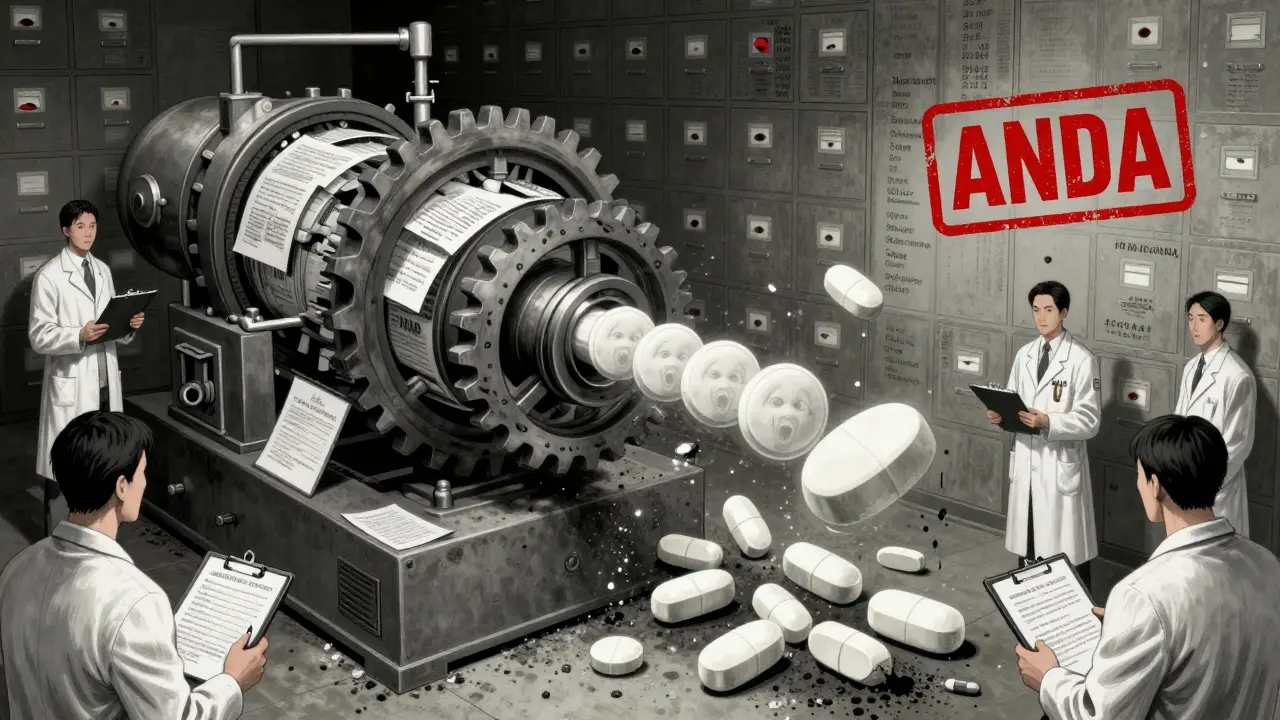
The formal application for a generic drug is called an Abbreviated New Drug Application, or ANDA. It’s called “abbreviated” because it skips the animal and human clinical trials that brand-name drugs go through. Instead, the ANDA focuses on chemistry, manufacturing, and bioequivalence data.
Here’s how the process breaks down:
- Filing Review-The FDA checks if the ANDA is complete. If it’s missing key data, they issue a Refuse-to-Receive letter. The company must fix and resubmit, paying another fee.
- Scientific Review-The Office of Generic Drugs (OGD) inside the Center for Drug Evaluation and Research (CDER) dives into the data. They look at manufacturing details, stability tests, and bioequivalence results.
- Patent Certification-The applicant must certify how their product interacts with any existing patents. A Paragraph IV certification means they’re challenging a patent. This triggers a 30-month legal stay if the brand company sues, delaying approval.
- Final Approval-Once all issues are resolved, the FDA issues approval. The drug is added to the Orange Book, which lists all approved generics and their therapeutic equivalence ratings.
The timeline? Under the Generic Drug User Fee Amendments (GDUFA), the FDA aims to review standard ANDAs in 10 months. Priority applications-like first generics or drugs in short supply-are reviewed in 8 months. That’s a huge improvement from the 180-day window under the original Hatch-Waxman rules.
Why This Matters: Cost and Access
Generic drugs cost, on average, 80-85% less than their brand-name counterparts. In 2022, the U.S. generic drug market was worth $125 billion. That’s not just a number-it’s millions of people who can afford their blood pressure meds, insulin, or antidepressants because generics exist.
The FDA approves about 800-900 original ANDAs each year. In 2023 alone, they approved 90 first-time generics. These aren’t just copies-they’re lifelines. For example, when the first generic version of Vivitrol (naltrexone extended-release injectable) was approved in 2023, it was a major win for opioid treatment programs. The FDA called it “of prime importance” given the ongoing public health crisis.
Challenges and Complexities
Not all generics are created equal. The ANDA system works beautifully for simple pills and capsules. But for complex products-like inhalers, topical creams, injectables with special delivery systems, or extended-release tablets-the science gets harder.
These aren’t just “copies.” They’re intricate drug delivery systems. Bioequivalence studies for inhalers, for instance, require specialized equipment and patient-specific testing. The FDA has launched initiatives like the Complex Generic Drug Product Development Resources to help manufacturers navigate these challenges.
Another hurdle? Patent thickets. Brand-name companies sometimes file dozens of minor patents around a single drug, creating legal roadblocks that delay generic entry for years. The FDA’s Drug Competition Action Plan tries to tackle this, but it’s an ongoing battle.
What’s New in 2026?
In October 2025, the FDA announced a new pilot program to speed up ANDA reviews for companies that manufacture and test their generics in the U.S. This isn’t just about speed-it’s about supply chain resilience. After pandemic-era shortages, the agency is prioritizing domestic production.
Also worth noting: while this article focuses on small-molecule generics, the future includes biosimilars-complex biologic drugs that mimic expensive biologics like Humira or Enbrel. These follow a different legal pathway under the BPCIA, but they’re part of the same goal: more affordable medicines.
Who Benefits?
Patients. Providers. Payors. The entire system. A 2023 FDA report showed that increasing generic availability directly improves access to care, especially for low-income populations. Pharmacists report fewer refusals at the counter. Insurance companies save billions. Hospitals cut drug spending. Even Medicare Part D savings are tied directly to generic use.
It’s not magic. It’s regulation. It’s science. And it’s working.
Are generic drugs as safe as brand-name drugs?
Yes. The FDA requires that generic drugs meet the same strict standards for identity, strength, purity, and quality as brand-name drugs. They must also prove bioequivalence-meaning they deliver the same amount of active ingredient into your bloodstream at the same rate. The same manufacturing facilities often produce both brand and generic versions. The FDA inspects all sites equally.
Why do generics look different from brand-name drugs?
Generics can differ in color, shape, size, or flavor because those are inactive ingredients, which are not required to match the brand. Only the active ingredient, dosage, strength, and performance must be identical. These differences don’t affect how the drug works.
How long does it take to get a generic approved?
Under current FDA guidelines, a standard ANDA takes about 10 months to review. Priority applications-like first generics or drugs in shortage-can be reviewed in as little as 8 months. This is a major improvement from the 180-day timeline under the original Hatch-Waxman Act, thanks to the GDUFA program.
Can a generic drug be approved before the brand-name patent expires?
Yes, but only if the generic manufacturer files a Paragraph IV certification, challenging the validity or applicability of the patent. If the brand company sues for infringement, the FDA is legally required to delay approval for up to 30 months. This is known as the 30-month stay. Many generics enter the market immediately after patent expiration or after winning a court case.
Are all generics made in the U.S.?
No. The majority of generic drug manufacturing happens overseas, particularly in India and China. However, the FDA inspects all facilities-whether in the U.S., India, or elsewhere-to ensure they meet the same quality standards. In 2025, the FDA launched a pilot program to prioritize reviews for generics made and tested in the U.S. to strengthen domestic supply chains.
Final Thoughts
The FDA’s authorization of generic drugs is one of the most effective public health policies in recent history. It’s not about cutting corners-it’s about removing unnecessary barriers. By letting generics use existing science, the system saves billions without sacrificing safety. The Hatch-Waxman Act didn’t just change the law-it changed lives. And as complex drugs become more common, the challenge isn’t to simplify the process, but to adapt it-so that affordability and access remain within reach for everyone.


11 Comments
John Smith
March 1, 2026 AT 15:03 PMLet me tell you something - this Hatch-Waxman Act is the reason I'm not bankrupt. My insulin used to cost $500 a month. Now? $12. And yeah, the pill looks different. Big fucking deal. The medicine works. The FDA didn't cut corners - they cut the bullshit. If you're still side-eyeing generics, you're either rich or you don't have a damn clue.
Sharon Lammas
March 3, 2026 AT 11:32 AMI've spent years sitting with patients who choose between food and medicine. The quiet miracle here isn't the science - it's the recognition that health isn't a luxury. The FDA didn't just approve drugs. They acknowledged that dignity shouldn't come with a price tag. Sometimes the most revolutionary acts are the ones that simply say: yes, this matters.
marjorie arsenault
March 3, 2026 AT 23:12 PMI work in a community pharmacy and I see this every day. A woman came in last week crying because her generic blood pressure med finally worked after three tries. She said, 'I thought I was being cheated.' I showed her the FDA sticker on the bottle. She hugged me. That's the real win. Not the savings. Not the science. The trust. We're rebuilding it, one pill at a time.
Shivam Pawa
March 4, 2026 AT 11:48 AMBioequivalence metrics are based on Cmax and AUC0-t with 80-125% confidence interval. The regulatory framework leverages 21 CFR 314.94 and 314.127. Manufacturing validation follows ICH Q7 guidelines. The ANDA submission must include DMF references. The FDA's OGD employs risk-based inspections under CGMP 21 CFR 211. The GDUFA commitments ensure review timelines are met with >90% compliance. The supply chain complexity necessitates real-time data integration from global facilities.
Darren Torpey
March 5, 2026 AT 21:30 PMI used to think generics were knockoffs. Then I got sick. Then I saw the price tag. Then I tried one. Then I lived. Turns out, the FDA doesn't play games. They do the math. And the math says: your life is worth more than corporate greed. I'm not just alive because of science. I'm alive because someone decided to make justice part of the prescription.
Lebogang kekana
March 7, 2026 AT 05:38 AMThis is not just about pills. This is about power. The system that once made medicine a weapon of economic control is now being turned into a tool of liberation. Every generic approved is a middle finger to Big Pharma. Every patient who gets their drug for $15 instead of $300? That's not a transaction. That's a revolution. And it's happening quietly, one tablet at a time. I'm not cheering. I'm witnessing history.
Jessica Chaloux
March 7, 2026 AT 16:21 PMI just cried reading this. 😭 My dad died because he couldn't afford his heart med. Now my mom takes the generic. She says it's 'the same but cheaper.' I don't know if it's the same. I just know she's still here. 🤍
Mariah Carle
March 8, 2026 AT 15:44 PMIt's fascinating how we've created a system where the most profound act of compassion is... regulatory efficiency. The FDA didn't invent empathy. But they built a machine that, through bureaucratic precision, delivers it to millions. We worship innovation. But here? The real miracle is consistency. The quiet, unsexy, paperwork-heavy commitment to sameness. That's the soul of healthcare.
Justin Rodriguez
March 9, 2026 AT 03:19 AMI've reviewed ANDA submissions. The bioequivalence studies are brutal. 24 healthy volunteers. Fasting. Blood draws every 15 minutes for 72 hours. The data is raw. Unfiltered. No marketing spin. Just numbers. And when those numbers match? That's not luck. That's rigor. The FDA doesn't cut corners. They just refuse to waste time on what's already proven.
Raman Kapri
March 9, 2026 AT 08:49 AMThe premise is flawed. The FDA's bioequivalence standards are based on flawed pharmacokinetic models that ignore inter-individual variability. Studies show up to 30% of patients experience clinically significant differences between brand and generic. The system is designed for profit, not patient outcomes. The 80-85% cost reduction is a statistical illusion masking real-world therapeutic divergence.
Megan Nayak
March 9, 2026 AT 22:57 PMYou call this progress? Let me break it down: 90% of prescriptions are generic. That means 90% of patients are being sold a product that, by definition, is not the original. The FDA calls it 'equivalent.' I call it compromise. And compromise in medicine? That's not science. That's capitalism wearing a white coat. The system isn't saving lives. It's optimizing margins. And we're all just too tired to notice.